
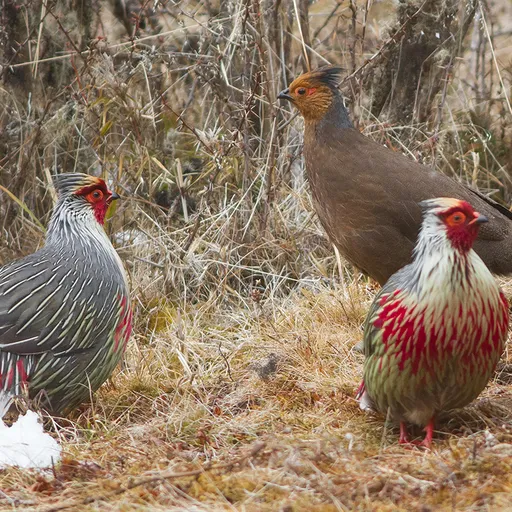
Blood Pheasant
Ithaginis cruentus
Least Concern
Overview
The blood pheasant, or Ithaginis cruentus, is a relatively small, short-tailed member of the pheasant family and the sole species within its genus. Widespread across the lower Himalayas and extending into China and Myanmar, it is classified as Least Concern with a stable global population.
Identification
- Approximately 43 cm in length with a short, convex, strong black bill and a small crest of variably coloured feathers.
- Upper plumage is dark ash with white shafts, while wing coverts are tinged with green and marked with broad white strokes.
- Chest and belly feathers have green tips with crimson margins, resembling scattered dashes of blood; the chin is deep crimson.
- Red feet and a distinct ring of bare skin around the eye that is typically crimson, though occasionally orange.
Habitat
The species inhabits the mountains of Nepal, Sikkim, northern Myanmar, Tibet, and central and south-central China, preferring coniferous or mixed forests and scrub areas near the snowline. It exhibits altitudinal migration, moving to higher elevations in the summer and descending to lower areas as snow accumulates in the autumn and winter.
Diet
The bird forages by following the snowline, consuming a diet that includes moss, ferns, pine shoots, and lichens.
Did you know?
Unlike most pheasants, the blood pheasant is strictly monogamous, with males actively defending the territory while the female incubates the 27-33 days of egg development.
Sources
- Wikipedia · CC BY-SA 4.0
- Wikidata · CC0 1.0