
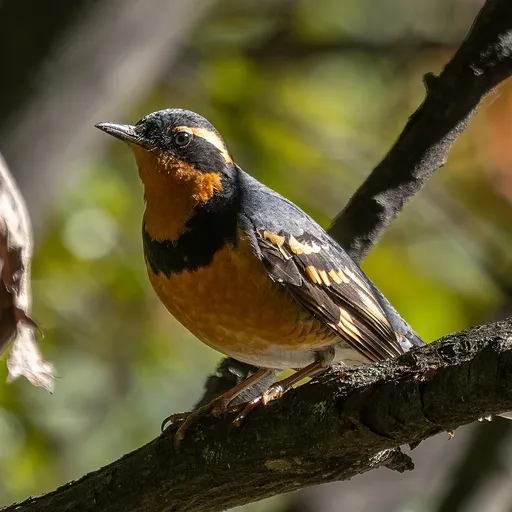
Varied Thrush
Ixoreus naevius
Least Concern
Overview
The varied thrush (Ixoreus naevius) is a fairly large thrush and the only member of the monotypic genus Ixoreus. Listed as Least Concern on the IUCN Red List, it breeds in western North America and is known for its striking colouration.
Identification
- Size and build: Ranges from 20 to 26 cm in length, similar in size to an American robin but with a heavier, more robust build.
- Male plumage: Features intense medium orange on the breast and throat with a curved grey pattern, along with greyish-blue tail ends, scruffs, and crowns.
- Female plumage: Markings are less defined, displaying olive-browns and greys with brown hind feathers.
- Features: Possesses a tan bill near the lower jaw and legs that are often tawny or dark brown.
Habitat
Breeds in moist, dense, and older coniferous forests at high elevations across western North America, from Alaska to northern California. During winter, it moves to lower elevations where it may be seen in towns, orchards, and thickets, and is a rare transatlantic vagrant in Great Britain.
Diet
Predominantly insectivorous in summer, foraging primarily on the ground for ground-dwelling arthropods. In winter and during migration, its diet shifts to include fruits, seeds, acorns, and a wide variety of berries such as snowberry, red huckleberry, and madrone.
Did you know?
There is an extremely rare variant where all orange plumage is replaced by white, with only five recorded sightings since 1921. A British vagrant of this type in 1982 led to speculation that the mutation causing this colour variation also affects the bird's navigational abilities.
Sources
- Wikipedia · CC BY-SA 4.0
- Wikidata · CC0 1.0