
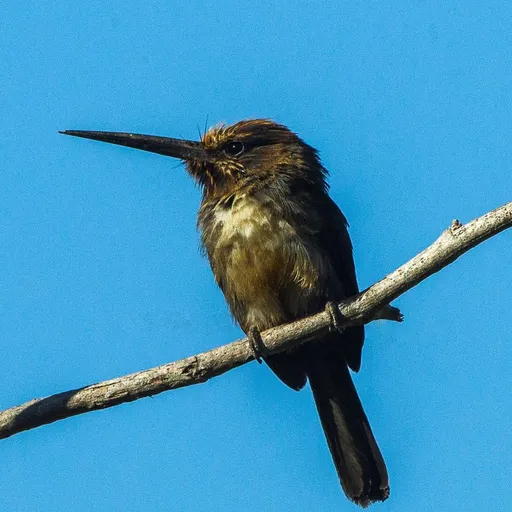
Three-toed Jacamar
Jacamaralcyon tridactyla
Near Threatened
Overview
The three-toed jacamar (Jacamaralcyon tridactyla) is a monotypic species in the family Galbulidae, distinguished by its possession of only three toes. It is a medium-sized, insectivorous bird that perches upright with its beak uptilted and is currently classified as Near Threatened.
Identification
- Measures 18 cm in length and weighs between 17.4 and 19.3 g, with females averaging heavier than males.
- Plummage is slaty black with a bronzy-green gloss above and paler below, featuring a white belly and centre of the breast.
- The adult has a brownish-gray cap and black throat, with the cap, chin, and sides of the head finely marked with pale fulvous streaks.
- Possesses a long, sharply pointed black bill and slaty gray feet that are zygodactyl but lack a hind toe.
- Song consists of a shrill series of short, ascending whistles lasting about 20 seconds, often sung in groups of two to six males.
Habitat
Endemic to the drier parts of the Atlantic Forest in southeastern Brazil, the species is now restricted primarily to the states of Rio de Janeiro and eastern Minas Gerais. It inhabits subtropical or tropical dry and moist lowland forests, as well as plantations, provided that a native understory layer persists. The bird is largely sedentary, though young birds disperse after fledging.
Diet
An insectivore that hunts from open perches in the forest understory or along the forest edge, sallying out to capture prey. It prefers small, cryptically colored moths and butterflies and Hymenoptera, but also consumes flies, dragonflies, beetles, true bugs, and termites. Captured insects are often beaten on a branch to stun them, remove stingers or venom, and detach their wings.
Did you know?
Unlike most members of its family, the three-toed jacamar possesses only three toes due to the absence of a hind toe and the fusion of the front two toes at the base. Its excavation of burrow nests in earthen banks is so vigorous that female museum specimens often show dirty and broken beaks, suggesting the female performs most or all of the digging.
Sources
- Wikipedia · CC BY-SA 4.0
- Wikidata · CC0 1.0