
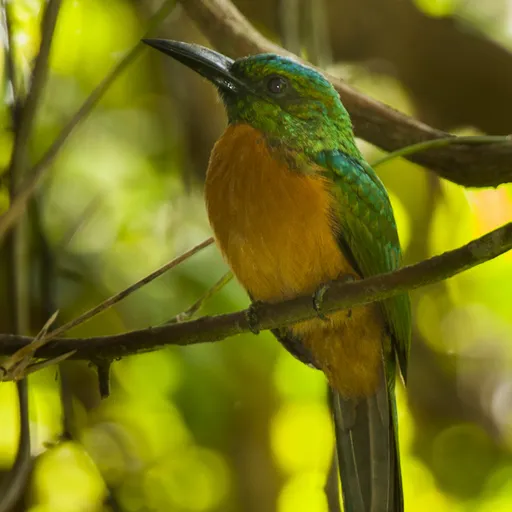
Great Jacamar
Jacamerops aureus
Least Concern
Listen
XC251029 · Niels Krabbe · Napo: 'Gareno (Guaponi) Lodge', Ecuador · CC BY-SA 4.0
Overview
The great jacamar (Jacamerops aureus) is the largest species in the family Galbulidae and is placed in the monotypic genus Jacamerops. It is a bird of subtropical and tropical moist lowland forests found across Central and South America. The species is currently classified as Least Concern on the IUCN Red List.
Identification
- Measures 25 to 30 cm in length and weighs between 57 and 70 g, making it bulkier than other jacamar species.
- Adult males feature bright metallic green with gold overtones on the upper regions, purple copper on the back, and a deep rufous lower body.
- Males have a white spot on the lower throat, which is absent in females.
- Possesses zygodactyl feet with two toes pointing forward and two backward, and a long, thin tongue.
Habitat
Found in Bolivia, Brazil, Colombia, Costa Rica, Ecuador, French Guiana, Guyana, Panama, Peru, Suriname, and Venezuela. It inhabits natural tropical forests up to 500 m altitude, typically occupying the middle levels of the canopy and the shaded edges of rainforests near stream banks.
Diet
Feeds on insects caught in flight and spiders on vegetation, occasionally consuming small vertebrates such as lizards. It forages by sitting in the canopy and following prey, beating it against a branch before consumption.
Did you know?
These birds are notoriously difficult to spot in the field because they sit in one spot for long periods of time. They construct their nests by boring holes into arboreal termitaria located 3 to 15 m above the ground.
Sources
- Wikipedia · CC BY-SA 4.0
- Wikidata · CC0 1.0