
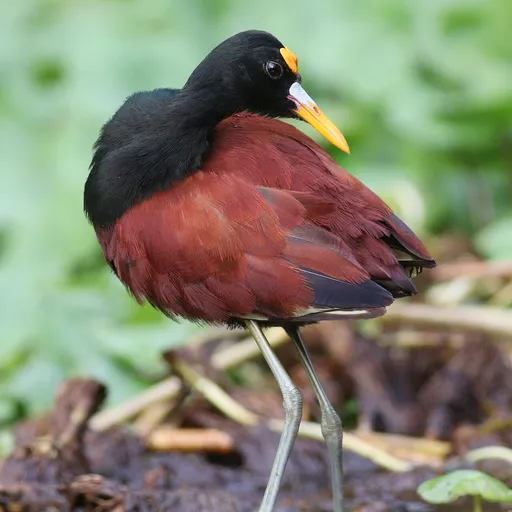
Northern Jacana
Jacana spinosa
Least Concern
Overview
The northern jacana, or Jacana spinosa, is a medium-sized wader found in wetlands across Central America and the Caribbean. It is a resident breeder from coastal Mexico to western Panama, as well as on Cuba, Jamaica, and Hispaniola, and is classified as Least Concern on the IUCN Red List.
Identification
- Chestnut-maroon body with a black head, neck, and breast.
- Bright yellow bill with a fleshy shield at the base of the forehead and a white base on the upper mandible.
- Long legs and elongated toes that enable it to walk on floating vegetation.
- Yellow bony spurs on the leading edge of the wings and yellowish-green primary and secondary wing feathers visible in flight.
Habitat
This species inhabits swamps, marshes, and ponds, relying on floating vegetation as its primary environment. Its range extends from Mexico to Panama, with occasional vagrants recorded in the southern United States, such as Arizona and Texas.
Diet
The northern jacana forages for insects on the surface of vegetation and consumes ovules of water lilies. Its diet also includes snails, worms, small crabs, fish, mollusks, and seeds.
Did you know?
The northern jacana has a polyandrous breeding system where females live in territories encompassing those of one to four males. Males are responsible for constructing the floating nests, incubating the eggs for 28 days, and brooding the chicks, while females may replace them after laying clutches due to the high energy costs of egg production.
Sources
- Wikipedia · CC BY-SA 4.0
- Wikidata · CC0 1.0