
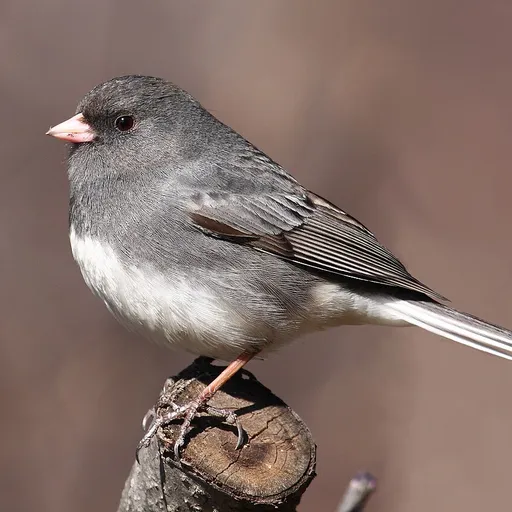
Dark-eyed Junco
Junco hyemalis
Least Concern
Listen
XC254480 · Jonathon Jongsma · Blue Bell Campground, Custer State Park, South Dakota, United States · CC BY-SA 4.0
Overview
The dark-eyed junco (Junco hyemalis) is a species of small, grayish New World sparrow that is common across much of temperate North America. It is characterised by high phenotypic diversity, with 14 or 15 recognised subspecies that interbreed extensively in areas of contact.
Identification
- Size: 13 to 17.5 cm long with a wingspan of 18 to 25 cm; body mass ranges from 18 to 30 g.
- Plumage: Generally features a gray head, neck, and breast, with gray or brown backs and wings, and a white belly; males tend to have darker, more conspicuous markings than females.
- Markings: Distinctive white outer tail feathers that flash during flight and hopping; bill is usually pale pinkish.
- Song: A trill similar to the chipping sparrow's, though the red-backed subspecies produces a more complex song; calls include tick sounds and high-pitched tinkling chips.
Habitat
Breeding habitat consists primarily of coniferous or mixed forest areas throughout North America, with northern birds migrating to winter quarters in the United States between mid-September and November. In winter, they are familiar in and around towns and are often the most common birds at feeders. The slate-colored subspecies is a rare vagrant to Western Europe and may successfully winter in Great Britain in domestic gardens.
Diet
These birds forage on the ground, often in flocks containing several different subspecies during winter. They mainly eat seeds, which comprise three-quarters of their year-round diet, and insects, which make up nearly half the diet of adults during the breeding season and the main diet for young juncos.
Did you know?
A flock of dark-eyed juncos is known to be called a blizzard.
Sources
- Wikipedia · CC BY-SA 4.0
- Wikidata · CC0 1.0