
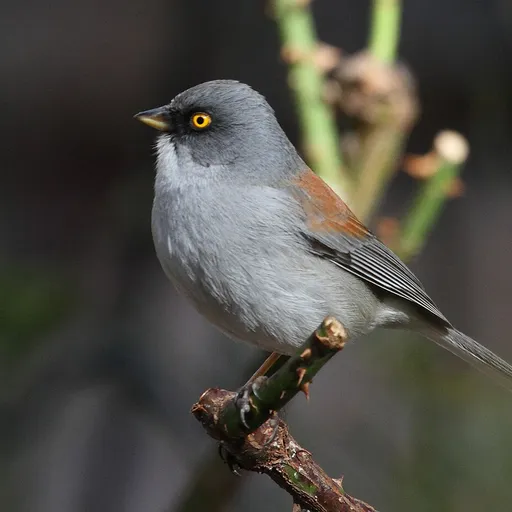
Yellow-eyed Junco
Junco phaeonotus
Least Concern
Overview
The yellow-eyed junco (Junco phaeonotus) is a species of bird in the family Passerellidae, also known as the New World sparrows. It is classified as Least Concern by the IUCN, with a stable estimated population of at least 4.3 million mature individuals.
Identification
- Approximately 16 cm long, with sexually dimorphic plumage; adult males of the nominate subspecies have a medium grey head with a black mask around the eye and rufous lower back and scapulars.
- Both sexes possess the eponymous bright yellow iris, a blackish upper bill, a pale yellow lower bill, and yellowish dusky pink legs.
- Males sing from prominent perches, producing a song described as a musical 'chip-chip-chip wheedle, wheedle che che che che che'.
- Subspecies vary in colouration, with some having ash-grey heads and white bellies, while others feature smoke-grey heads and brown flanks.
Habitat
This montane species inhabits pine and pine-oak forests, scrublands, and brushy pastures in the upper subtropical and temperate zones. Its range extends from the south-western United States to Guatemala, typically found at elevations between 1,200 and 3,500 m, though mostly above 2,000 m.
Diet
The yellow-eyed junco feeds mostly on insects during the breeding season, supplementing its diet with other arthropods and seeds at other times. It forages primarily on the ground by scratching through leaf litter and soil, but also gleans prey from branches, strips seeds from plants, catches insects in mid-air, and feeds on sap from woodpecker holes.
Did you know?
While the female alone incubates the eggs, males sometimes bring building materials to the nest site, which is typically constructed by the female scraping a hollow in the ground in a shady location.
Sources
- Wikipedia · CC BY-SA 4.0
- Wikidata · CC0 1.0