
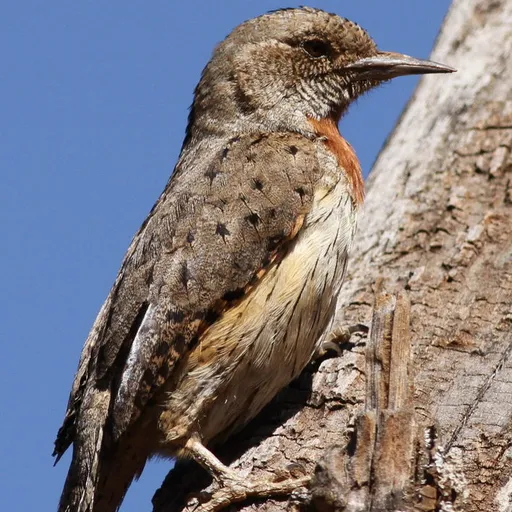
Red-throated Wryneck
Jynx ruficollis
Least Concern
Overview
The red-throated wryneck, also known as the rufous-necked wryneck, is a species of wryneck in the woodpecker family closely related to the Eurasian wryneck. It is a slim, elongated bird resident in much of sub-Saharan Africa, found in open habitats with some trees.
Identification
- A slim, elongated bird about 19 cm (7.5 in) in length with a small head, fine bill, and long fan-shaped tail.
- Overall cryptic plumage intricately patterned in greys, browns, and black, with upperparts that are brown, barred, and mottled in dark shades.
- The chin, throat, and breast of the nominate subspecies are red, while the lower breast and belly are white with dark streaks.
- The call consists of a series of repeated harsh, shrill notes described as kweek-kwik-kwee-quee.
- When threatened, the bird twists its neck and head in a snake-like manner while making a hissing sound.
Habitat
The red-throated wryneck has a distribution confined to sub-Saharan Africa, occurring in about 20 countries in disjunct areas from Nigeria and Ethiopia in the north to South Africa and Eswatini in the south. Its typical habitat is open grassland with trees, particularly acacia and miombo woodlands, but it also inhabits semi-open woodland such as forest edges and clearings. It utilises man-made habitats like farmland, parks, and gardens provided trees are present, occurring at altitudes from 600 to 3,300 metres.
Diet
The diet of adults and young is almost entirely ants at all stages of their life cycles, though termites and other small invertebrates are occasionally taken. Prey items are gleaned with its long sticky tongue, and as a solitary feeder, 90% of its foraging takes place on the ground by probing into ant hills. When feeding in trees, it picks prey off vegetation but does not excavate.
Did you know?
When threatened, the bird will twist its neck and head in a snake-like manner while making a hissing sound, presumably to deter predators. This defensive behaviour is so characteristic that the English name 'wryneck' refers to this habit of twisting and writhing the necks when agitated.
Sources
- Wikipedia · CC BY-SA 4.0
- Wikidata · CC0 1.0