
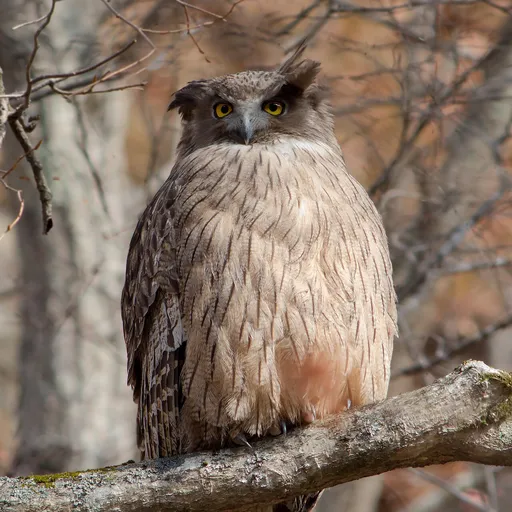
Blakiston's Fish Owl
Ketupa blakistoni
Overview
Blakiston's fish owl (Ketupa blakistoni) is the largest living species of owl and a member of the eagle-owl group that specialises in hunting in riparian areas. Native to China, Japan, and the Russian Far East, it is the only surviving species of its genus that is closely related to the Eurasian eagle-owl.
Identification
- Plumage: More monochromatically brown to tan than similar eagle-owls, with buff-brown upperparts heavily streaked with darker brown and paler underparts featuring wavy cross-patterns.
- Structure: Possesses a relatively long bill, husky body, and long wings, while retaining the fully feathered tarsi and silent wing beats characteristic of eagle-owls rather than other fish owls.
- Ear tufts: Broad and ragged, hanging slightly to the side and appearing non-upright, unlike the distinct upright tufts of most eagle-owls.
- Call: A deep, synchronized duet that may sound like a single bird; in the mainland subspecies, it consists of a four-note pattern (e.g. 'HOO-hoo, HOBO-hoooo'), while the Japanese subspecies features a two-note male call and one-note female response.
Habitat
The species occupies dense, minimally disturbed old-growth forests near waterways, including floodplains and wooded coastlines, requiring large tree cavities for nesting. It is found in the taiga zone and mixed forests, typically near productive rivers, springs, or shoals that remain partially unfrozen in winter to support its food supply.
Diet
Primarily piscivorous, feeding on large fish such as pike, catfish, trout, and salmon, and is capable of hauling prey two to three times its own body weight. In spring, especially in Russia, amphibians such as Dybowski's frog may temporarily outnumber fish in the diet, while mammals including martens, hares, and even domestic cats are taken opportunistically, particularly in winter.
Did you know?
The breeding duet of pairs is so synchronised that observers unfamiliar with the call often mistake it for a single bird vocalising. Additionally, early naturalists incorrectly believed the Blakiston's fish owl and the brown fish owl belonged to the same species, despite their ranges being separated by approximately 2,000 km.