
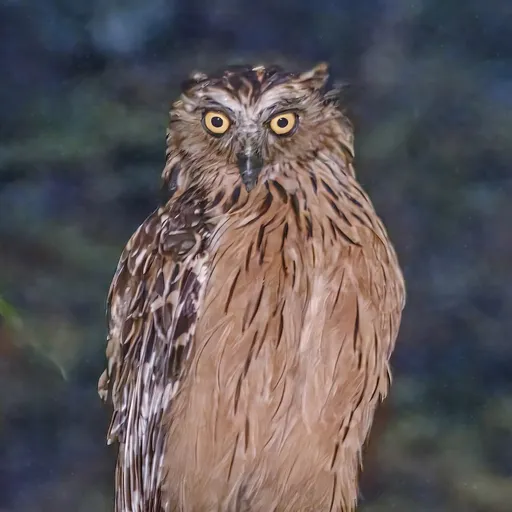
Buffy Fish Owl
Ketupa ketupu
Least Concern
Overview
The buffy fish owl, also known as the Malay fish owl, is the smallest species of fish owl in the family Strigidae. It is a resident bird of Southeast Asia that is classified as Least Concern on the IUCN Red List due to its wide distribution and assumed stable population.
Identification
- A buff brown bird with darker tawny brown feathers on the back, a paler face, and light brown eyebrows.
- The wings and tail are broadly barred yellowish and dark brown, with the wings being distinctly rounded in shape.
- Underparts are yellowish brown, rich buff, or fulvous with broad, blackish shaft stripes, and the long legs are unfeathered.
- Prominent ear tufts on the sides of the head and a bill placed between the eyes, giving a remarkably morose and sinister expression.
- Vocalisations include hissing, a rapidly repeated rattling kutook, a ringing loud pof-pof-pof, and a high hawk-like hie-e-e-e-e-keek.
Habitat
Native to Southeast Asia, its range extends from Bangladesh, Myanmar, Thailand, Malaysia, and Singapore to Cambodia, Laos, Vietnam, and the Sunda Islands. It inhabits tropical forests and freshwater wetlands near rivers, lakes, and aquaculture sites up to an elevation of 1,600 m, as well as plantations and rural and urban gardens.
Diet
The buffy fish owl feeds primarily on fish, crabs, frogs, small reptiles, and birds, and also forages on carrion. It hunts mainly from the bank, swooping down in a manner similar to a fish eagle, or by walking into shallow streams and brooks, ensuring it never gets its feathers wet. It does not produce firm pellets, instead ejecting bones and remains in pieces to the ground below the roost.
Did you know?
Unlike most owls that build nests, the buffy fish owl creates a mere scrape on the surface of a large fern, often nesting on top of a Asplenium nidus fern or in the fork of a tall bough covered in ferns and moss. It holds the record for the smallest clutch size of any owl, with only ever one egg recorded per breeding season, shared only with the spot-bellied and barred eagle owls.
Sources
- Wikipedia · CC BY-SA 4.0
- Wikidata · CC0 1.0