
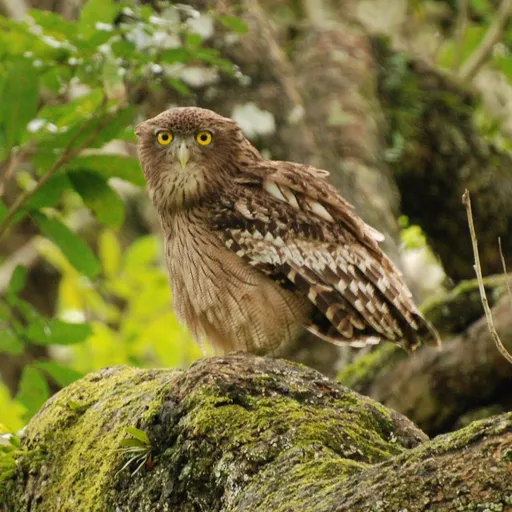
Brown Fish Owl
Ketupa zeylonensis
Least Concern
Overview
The brown fish owl (Ketupa zeylonensis) is a nocturnal species of fish owl native to Turkey, the Middle East, and South and Southeast Asia. As the most widely distributed, common, and best-studied of the four living fish owl species, it occupies a vast range exceeding 7,000 km and is currently classified as Least Concern on the IUCN Red List.
Identification
- Plumage: Rufous brown upperparts heavily streaked with black or dark brown; buffy-fulvous to whitish underparts with wavy dark brown streaks and finer barring; conspicuously puffed white throat.
- Structure: Ranges from 48 to 61 cm in length with a 125 to 140 cm wingspan; features prominent ear tufts, an indistinct facial disc, and a dark bill positioned between the eyes, imparting a "morose and sinister expression".
- Feet and Eyes: Golden yellow irises and featherless yellow feet; toes have a rough texture adapted for grasping slippery fish, unlike the soft feathers of most other owls.
- Wingbeat: Wing beats produce a noticeable sound, sometimes described as "singing," because the species lacks the specific feather specializations that allow other owls to fly silently.
Habitat
This owl inhabits forests and wooded wetlands, typically found near streams, lakes, rice fields, or sea coasts. It prefers lowlands ranging from open woodland to dense forests and plantations, occasionally reaching submontane forests in the Himalayan foothills up to 1,500 m above sea level. It is an all-year resident that rarely strays far from larger bodies of water, though western populations may breed in oases within semiarid landscapes.
Diet
The brown fish owl primarily feeds on fishes, frogs, and aquatic crustaceans such as Potamon crabs, often selecting larger freshwater fish. It forages by stationing itself on a rock overhang or perch, gliding over the water to snatch prey, or wading into shallow waters to hunt. While it mainly consumes aquatic prey, it also takes snakes, lizards, small mammals, and occasionally water birds, and may scavenge carrion such as putrefying crocodiles when hungry.
Did you know?
Unlike most owls, the brown fish owl's wing beats make a noise, sometimes described as "singing," due to a lack of the comb and hair-like feather fringes that allow other owls to fly silently. Additionally, its bill is positioned between the eyes rather than below them, giving the bird a remarkably morose and sinister expression.
Sources
- Wikipedia · CC BY-SA 4.0
- Wikidata · CC0 1.0