
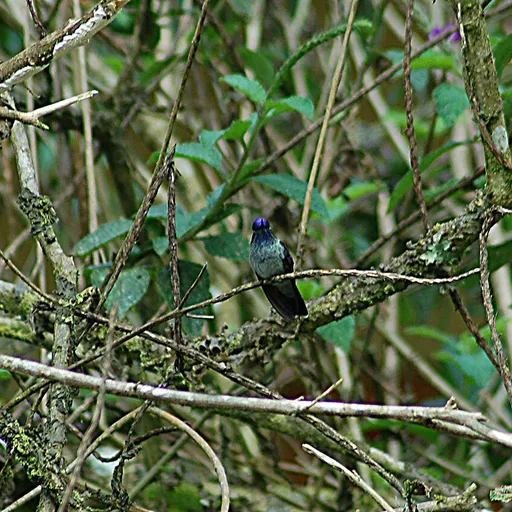
Violet-headed Hummingbird
Klais guimeti
Least Concern
Overview
The violet-headed hummingbird (Klais guimeti) is a small avian species and the sole representative of the genus Klais. It is classified as a species of Least Concern by the IUCN due to its extensive distribution and adaptability to human-modified environments.
Identification
- Males display an intense violet or blue head and throat, contrasted by distinct white spots behind each eye, while females exhibit a duller blue cap and grey underparts.
- The plumage includes a metallic bluish-green or bronze-green back, a green breast fading to a grey belly, and black wings.
- The bird averages 8.1 cm in length with a short, straight bill measuring approximately 13 mm.
Habitat
This species inhabits subtropical or tropical moist lowland and montane forests, as well as heavily degraded former forests. Its range extends from Honduras and Nicaragua through Central America to western South America, including Venezuela, Colombia, Ecuador, Peru, northern Brazil, and northern Bolivia. The bird occupies elevations ranging from 150 m to 1,900 m, frequently favouring forest edges, shrub clearings, and human-modified areas such as coffee plantations.
Diet
The violet-headed hummingbird feeds on nectar from understory flowering shrubs and captures small insects on the wing. In Costa Rica, it shows a particular preference for Stachytarpheta flowers, with individuals sometimes found at intervals of 5–7 m along hedges.
Did you know?
The genus Klais is named after Kleis, the daughter of the ancient Greek poet Sappho. Males perform in loose leks from heights of 5 to 18 m, singing from slender dead twigs at the edges of clearings.
Sources
- Wikipedia · CC BY-SA 4.0
- Wikidata · CC0 1.0