
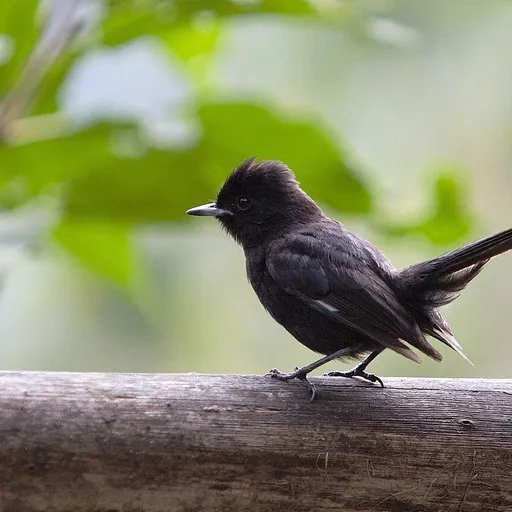
White-winged Black Tyrant
Knipolegus aterrimus
Least Concern
Overview
The white-winged black tyrant, Knipolegus aterrimus, is a species of tyrant flycatcher found across parts of South America. It inhabits a variety of open arid and semi-arid landscapes, though its distribution is disjunct with distinct subspecies occupying different regions. The species is currently classified as Least Concern by the IUCN.
Identification
- Adult males of the nominate subspecies are almost entirely shiny black, while females have grayish-brown upperparts and buffy-ochraceous underparts with a cinnamon-rufous rump.
- Wings feature a wide white band on the inner webs of the primaries and secondaries that is highly conspicuous in flight but usually hidden when perched.
- Males possess a blue-grey bill with a black tip, whereas females have a black bill with a bluish base to the mandible.
- Song varies by region and subspecies; for example, northern nominate males sing a low-pitched mechanical tok followed by high-pitched buzzy notes, while anthracinus males sing a thin, buzzy pi-dri'DZEER.
Habitat
The species inhabits scrublands, woodlands, forest edges, and secondary forest in open arid and semi-arid environments. It is found in Argentina, Bolivia, Paraguay, and Peru, with a disjunct range for the heterogyna subspecies in Peru's Marañón River valley. Elevation typically ranges between 1,500 and 3,000 m, though individuals can occasionally be found between 250 m and 3,800 m.
Diet
The white-winged black tyrant feeds primarily on insects, though specific dietary details are lacking. It forages singly, perching erect in the open or in the canopy to make sallies for prey in foliage or to pounce on the ground.
Did you know?
Males perform a distinctive display flight that involves pausing at the peak and dropping with open wings to a perch, producing clicks and buzzes with their bill and wings. The nest is an open cup constructed from twigs and lined with feathers and hair, placed low in vegetation or directly on the ground.
Sources
- Wikipedia · CC BY-SA 4.0
- Wikidata · CC0 1.0