
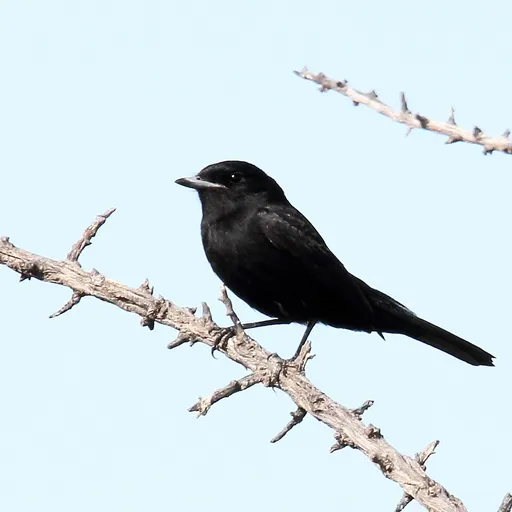
Hudson's Black Tyrant
Knipolegus hudsoni
Least Concern
Overview
Hudson's black tyrant (Knipolegus hudsoni) is a species of tyrant flycatcher found across parts of South America. It is a complete migrant that breeds in central to southern Argentina and moves north for the winter. The species is classified as Least Concern by the IUCN, with a stable population across a large range.
Identification
- Adult males are almost entirely shiny black, featuring a wide white band on the inner webs of the primaries that is conspicuous in flight but usually hidden when perched.
- Adult females have a grayish brown head and upperparts with a rufous rump, while their underparts are buffy to ochre with dusky-olive streaks.
- Both sexes possess a red iris, a blue-gray bill with a black tip, and black legs and feet.
- Vocalisations include irregular 'ric-tic-titireetic' and snapping sounds.
Habitat
The species inhabits somewhat open woodland and scrubland, mostly below 500 m in elevation. In northern parts of its range, it also uses Gran Chaco woodlands, shrubby pastures, and gardens. Its range extends from northern Bolivia south through western Paraguay into Argentina as far as eastern Neuquén, northern Río Negro, and southwestern Buenos Aires provinces.
Diet
Hudson's black tyrant feeds on insects. It usually forages in dense cover near the ground, though little else is known about its specific foraging behaviour or dietary details.
Did you know?
The species is monotypic and was named to honour Argentine-British ornithologist William Henry Hudson, who collected the first four specimens.
Sources
- Wikipedia · CC BY-SA 4.0
- Wikidata · CC0 1.0