
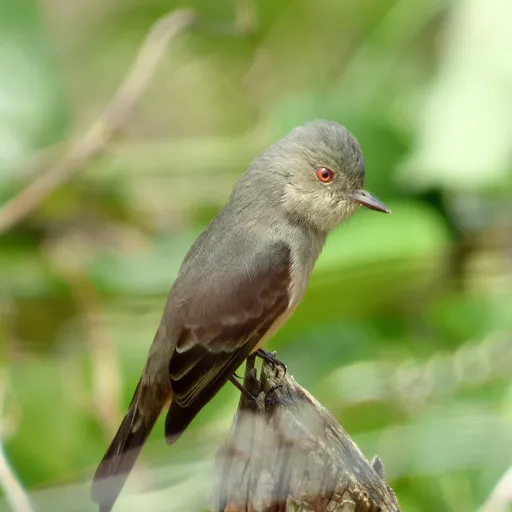
Rufous-tailed Tyrant
Knipolegus poecilurus
Least Concern
Overview
The rufous-tailed tyrant (Knipolegus poecilurus) is a species of tyrant flycatcher found across parts of South America. It is classified as Least Concern by the IUCN, though it is described as local or uncommon within its extensive range.
Identification
- 14.5 to 15 cm in length, weighing between 13 to 15 g.
- Mostly greyish to brownish upperparts with a whitish throat; wings are dusky with buff edges that show as two wing bars in the nominate subspecies.
- Tail is dusky with wide cinnamon edges that are conspicuous in flight, particularly in adults.
- Possesses a red iris, a longish black bill, and black legs and feet.
- Vocalisations include short, metallic trills and high-pitched, raspy notes.
Habitat
This species inhabits a variety of somewhat open landscapes, including the edges and clearings of humid montane forest, shrubby areas, pastures with scattered trees, and secondary forest. It occurs at elevations ranging from 500 m in Brazil to 2,500 m in Colombia, often occupying stunted second-growth forest on white-sand soils in southern Venezuela.
Diet
The rufous-tailed tyrant feeds on insects, usually foraging singly or in pairs and only rarely joining mixed-species flocks. It perches upright in bushes or on open structures, often lifting and slowly dropping its tail, and takes most prey in mid-air via a short sally or by dropping to the ground.
Did you know?
Although it is a year-round resident, the bird is known to make local movements into freshly opened areas, such as landslides.
Sources
- Wikipedia · CC BY-SA 4.0
- Wikidata · CC0 1.0