
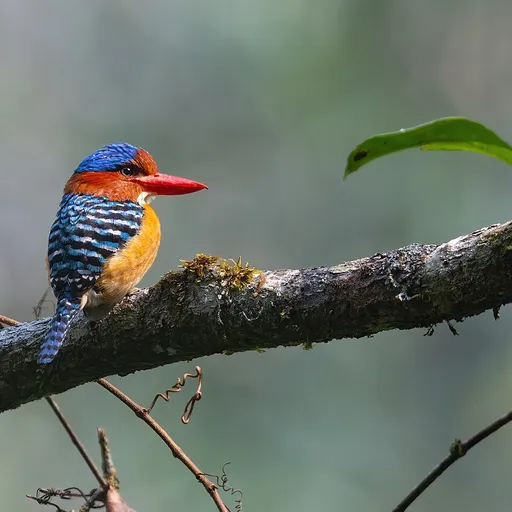
Banded Kingfisher
Lacedo pulchella
Least Concern
Overview
The banded kingfisher (Lacedo pulchella) is a tree kingfisher found in the lowland tropical forests of southeast Asia. It is the sole member of the genus Lacedo and is classified as Least Concern on the IUCN Red List.
Identification
- Males feature a bright blue cap and chestnut forehead, contrasting with black and blue banding on the upperparts and a rufous breast with a white central belly.
- Females display black-and-rufous banding on the upperparts and white underparts marked with black bars on the chest and flanks.
- The bird is approximately 20 cm long with a sturdy red bill and a short crest that is slowly raised and lowered.
- Its call consists of a long whistled wheeeoo followed by 15 repetitions of chiwiu within 17 seconds.
Habitat
This species inhabits lowland rainforests in Myanmar, Thailand, Cambodia, Vietnam, Laos, Malaysia, Sumatra, Java and Brunei, typically at altitudes below 1,100 m, though it can be found up to 1,700 m in Brunei. It is notably rare in Java, very rare in Sumatra, and is now extinct in Singapore.
Diet
The banded kingfisher primarily hunts large insects and occasionally small lizards. It usually takes its prey in the trees, but sometimes forages from the ground.
Did you know?
Unlike most other kingfishers, this species does not require pools or streams within its territory. Additionally, it will respond to imitations of its own distinctive call.
Sources
- Wikipedia · CC BY-SA 4.0
- Wikidata · CC0 1.0