
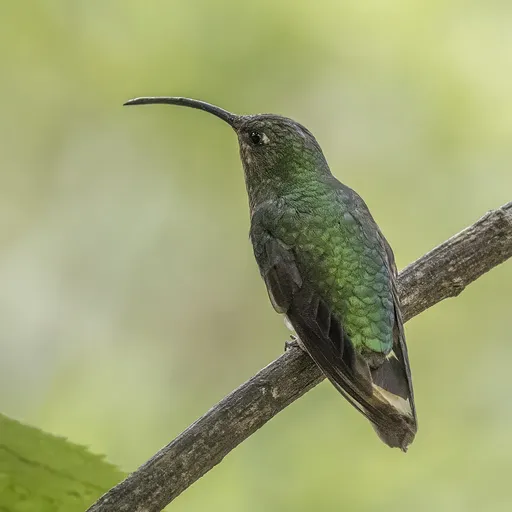
Mountain Velvetbreast
Lafresnaya lafresnayi
Least Concern
Listen
XC251032 · Niels Krabbe · Pichincha: Yanacocha, Volcán Pichincha, Ecuador · CC BY-SA 4.0
Overview
The mountain velvetbreast (Lafresnaya lafresnayi) is a species of hummingbird in the 'brilliants' tribe. It is the only member of its genus and is assessed as Least Concern on the IUCN Red List.
Identification
- Length of 11.5 to 12 cm including a thin, decurved black bill that varies in curvature among subspecies.
- Males of the nominate subspecies have grass green upperparts, iridescent emerald green throat and breast, and a velvet black belly.
- Females have buff underparts with iridescent green spots, while all subspecies feature a distinctive white spot behind the eye.
- Calls include a repeated high-pitched 'tseee' or 'pseeuw', sometimes followed by a stuttering descending series, along with soft 'tek' notes and a thin rattle.
Habitat
Found in Colombia, Ecuador, Peru, and Venezuela, the species primarily inhabits the edges of humid montane forest and shrubby slopes, though it uncommonly occurs within the forest itself. It generally ranges in elevation from 1,800 to 3,400 m, being most numerous between 2,000 and 2,800 m.
Diet
The bird feeds on nectar from a variety of plants with long tubular flowers, with a special preference for the genus Siphocampylus. Males defend feeding territories, whereas females forage by trap-lining. Both sexes also capture small arthropods by gleaning from foliage and hawking.
Did you know?
Males and females forage differently, with males defending specific feeding territories while females travel a circuit of sites known as trap-lining. The species makes seasonal movements between lower elevation forests and higher páramo.
Sources
- Wikipedia · CC BY-SA 4.0
- Wikidata · CC0 1.0