
African Firefinch
Lagonosticta rubricata
Least Concern
Overview
The African firefinch, also known as the blue-billed firefinch, is a small estrildid finch species native to many parts of Africa. It is classified as Least Concern on the IUCN Red List and possesses a vast global extent of occurrence estimated at 5.4 million square kilometres.
Identification
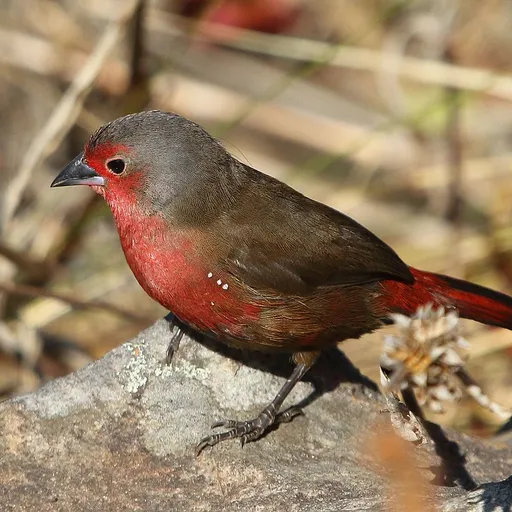
- Males feature a lead grey crown and nape that merge into olive brown mantles, with a deep carmine red rump and uppertail coverts.
- Underparts are deep scarlet with small white spots on the upper breast and flanks, transitioning to a greyish centre and black vent.
- Females resemble males but are less intensely coloured, while juveniles lack any red on the underparts.
- The bird is 10–11 cm long with a short, pointed blackish-grey bill that has a pink base to the lower mandible.
Habitat
Found in patches across sub-Saharan Africa, ranging from Senegal east to Ethiopia and south to the Eastern Cape of South Africa. The species generally prefers humid, thickly vegetated habitats such as bracken at forest edges, savanna with acacia woodland, and rank grass within scrub or thornbush. It is also occasionally seen in gardens and rural villages, though less commonly than some other firefinch species.
Diet
The African firefinch primarily feeds on seeds, which are supplemented with insects. It forages mostly on the ground by searching through the soil for food, typically occurring in pairs or small family parties that stay close to cover.
Did you know?
The dusky indigobird acts as a brood parasite of the African firefinch, laying its eggs in the host's nest to have them raised by the firefinch parents.
Sources
- Wikipedia · CC BY-SA 4.0
- Wikidata · CC0 1.0