
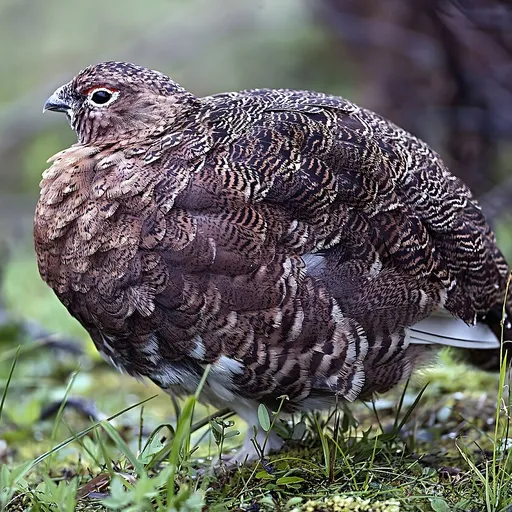
Willow Ptarmigan
Lagopus lagopus
Least Concern
Listen
XC803775 · Grégoire Chauvot · Kvaløyvågen, Tromsø, Troms og Finnmark, Norway · CC0 1.0
Overview
The willow ptarmigan, also known as the willow grouse, is a medium to large, ground-dwelling bird within the pheasant family. It is the most numerous of the three species of ptarmigan and is classified as a species of least concern by the IUCN.
Identification
- Size and shape: Medium to large and deep-chested with a fairly long neck, broad bill, short feathered legs, and a moderately short, rounded tail.
- Summer plumage: The male is marbled brown with a reddish hue to the neck and breast, a black tail, and white wings and underparts, featuring red, semicircular combs above the eyes; the female is similar but has smaller eye combs and brown feathers scattered among the white on her belly.
- Winter plumage: The body plumage and central tail feathers of both sexes become completely white, except for the black outer tail feathers, while wing feathers remain white year-round.
- Voice: Low-pitched and guttural, including chuckles, repeated clucking sounds, and expostulations, with males making rattles and barking noises during display.
Habitat
Possessing a circumboreal distribution, the willow ptarmigan inhabits subalpine and subarctic environments such as sparse pine and birch forests, thickets with willow and alder trees, heather moors, tundra, and mountain slopes across northern Europe, Siberia, Alaska, and Canada. In winter, females and subadults may migrate to lower altitudes and seek shelter in valleys or more densely vegetated areas, whereas adult males usually remain in subalpine regions.
Diet
Largely herbivorous, the willow ptarmigan feeds on leaves, flowers, buds, seeds, and berries in summer, while subsisting mainly on the buds and twigs of willow and other dwarf shrubs during winter. Juveniles consume insects due to an inability to digest plant material caused by underdeveloped ceca, and in areas with heavy snowfall, adults are restricted to browsing taller willow species that poke through the snow.
Did you know?
Users of social media platforms have popularly dubbed the willow ptarmigan 'the awebo bird' because its distinctive call sounds like the expression 'awebo', a corruption of the vulgar Mexican Spanish slang phrase a huevo.
Sources
- Wikipedia · CC BY-SA 4.0
- Wikidata · CC0 1.0