
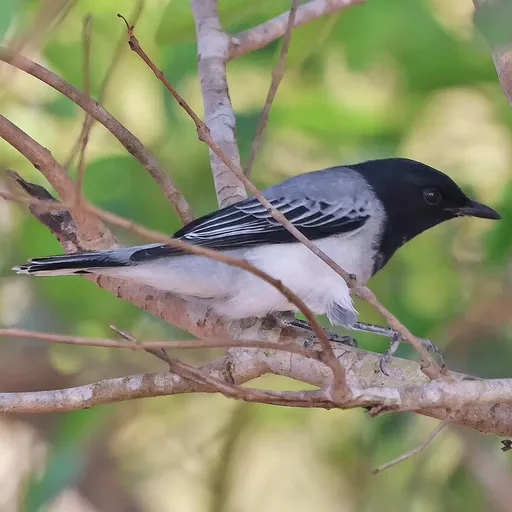
Black-headed Cuckooshrike
Lalage melanoptera
Least Concern
Overview
The black-headed cuckooshrike (Lalage melanoptera) is a slender bird species found across the Indian subcontinent and Southeast Asia. It is classified as a species of concern only at the lowest level, currently listed as Least Concern on the IUCN Red List.
Identification
- Males feature a dark slaty-grey hood, neck, and upper breast, contrasting with a pale grey back, white belly, and blackish wings with grey edges.
- Females are duller with brownish-grey upperparts, a whitish supercilium, heavily barred underparts, and a dark grey bill.
- The bird is 18–20 cm in length and exhibits an undulating, dipping flight pattern, often shuffling its wings upon landing.
- Its song consists of clear, mellow, whistled notes such as "twit-wit-wit-wee-twéé-twéé-twy-twy-twy", accompanied by a rapid, high-pitched call.
Habitat
Found across the Indian subcontinent, including India, Bangladesh, Sri Lanka, Nepal, Bhutan, and Myanmar, this species inhabits open dry-deciduous or semi-evergreen forests, secondary growth, bamboo patches, and urban gardens up to 2,100 meters. It prefers open wooded habitats over dense forests and is often resident, though it acts as a summer breeding visitor in Himalayan foothills and North India before moving to lower altitudes in winter.
Diet
Primarily insectivorous, this bird forages methodically in the canopy of tall trees, often joining mixed-species flocks to search foliage for caterpillars, beetles, ants, and cicadas. It supplements its diet with fruits, including Lantana berries and figs.
Did you know?
Like other cuckooshrikes, this species has a characteristic habit of rearranging or shuffling its wings upon landing. Its nest is typically bound together with cobwebs and placed 2–8 meters high in the fork of a bare branch.
Sources
- Wikipedia · CC BY-SA 4.0
- Wikidata · CC0 1.0