
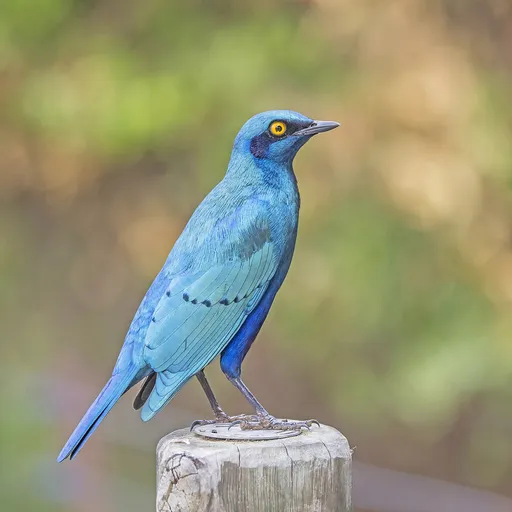
Greater Blue-eared Starling
Lamprotornis chalybaeus
Least Concern
Overview
The greater blue-eared starling (Lamprotornis chalybaeus) is a very common open woodland bird that breeds from Senegal east to Ethiopia and south through eastern Africa to northeastern South Africa and Angola. It is classified as Least Concern on the IUCN Red List.
Identification
- 22 cm long, short-tailed bird with glossy blue-green plumage.
- Purple-blue belly and blue ear patch, contrasting with bright yellow or orange irises.
- Juveniles appear duller with blackish brown underparts, while sexes are similar in appearance.
- Distinctive song includes a range of musical or grating calls, most famously a nasal squee-ar.
Habitat
This species inhabits open woodlands across a vast range, breeding from Senegal east to Ethiopia and south to northeastern South Africa and Angola. It undertakes some seasonal migration within this distribution.
Diet
An omnivore that primarily consumes insects taken from the ground, though it also feeds on a wide range of invertebrates, seeds, and berries, especially figs. It is known to perch on livestock to feed on disturbed insects and occasionally remove ectoparasites.
Did you know?
The greater blue-eared starling is highly gregarious and will nest inside the large stick nests of the sacred ibis or Abdim's stork.
Sources
- Wikipedia · CC BY-SA 4.0
- Wikidata · CC0 1.0