
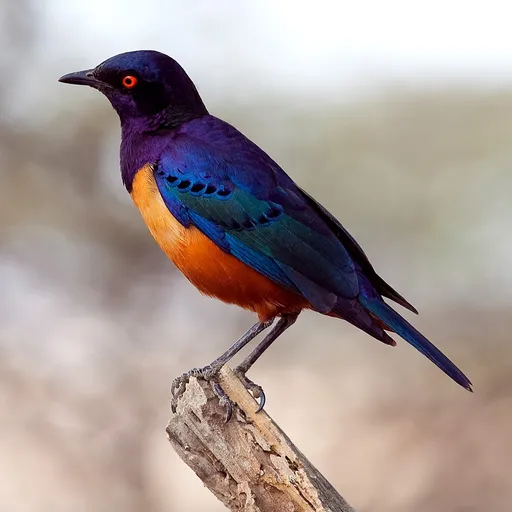
Hildebrandt's Starling
Lamprotornis hildebrandti
Least Concern
Overview
Hildebrandt's starling (Lamprotornis hildebrandti) is a species of starling in the family Sturnidae, native to Kenya and Tanzania. It is currently classified as Least Concern on the IUCN Red List, indicating it is not considered threatened despite varying in local abundance.
Identification
- Adults possess bright iridescent plumage with a blue head and upperparts, bronze-green wings with blue primaries, and a glossy purple throat and upper breast.
- The lower body features an orange-buff middle breast and upper belly, transitioning to a rufous lower belly, while the bill, legs, and iris (orange-red) are distinct in colour.
- The species produces a slow, low song described as "ch-rak ch-rak chee-chee-wee chee-wee rak rak rak", along with specific alarm and contact calls.
- Juveniles differ significantly from adults, displaying charcoal grey upperparts and chestnut brown lowerparts.
Habitat
Found in Kenya and Tanzania, this species occupies open country at elevations between 500 and 2,200 metres. It primarily inhabits open woodland and open thornbrush environments, where it may appear fairly common or uncommon depending on the location.
Diet
The diet consists mainly of insects, including beetles and grasshoppers, supplemented by fruit and seeds from species such as Carissa edulis and Euclea. Foraging typically occurs on the ground in pairs or small flocks, often following large mammals to catch flushed prey, and the species will also hawk for flying termites.
Did you know?
Hildebrandt's starling is a cavity nester that often repurposes abandoned woodpecker holes, but will also utilise man-made structures such as fence posts, lampposts, or telegraph poles when natural cavities are unavailable.
Sources
- Wikipedia · CC BY-SA 4.0
- Wikidata · CC0 1.0