
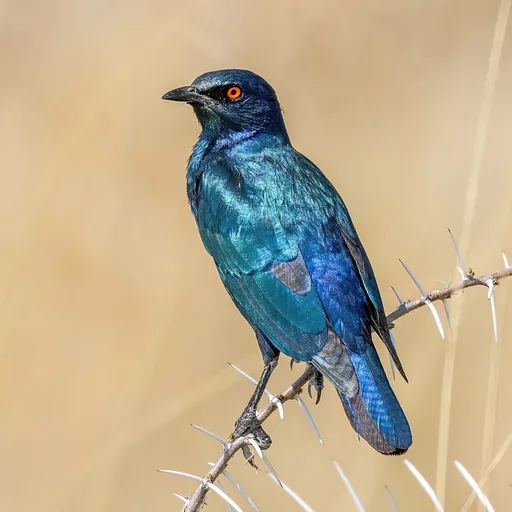
Cape Starling
Lamprotornis nitens
Least Concern
Overview
The Cape starling, also known as the red-shouldered glossy-starling, is a species of starling in the family Sturnidae. It is a non-migratory resident found across Southern Africa, where it thrives in various open and semi-open environments.
Identification
- Adult length of about 25 cm and weight of approximately 100 grams.
- Uniformly bright, glossy plumage featuring a blue head with darker ear coverts and greenish-blue upper body parts.
- Possesses a lengthy warbling song that often includes imitations of environmental sounds.
Habitat
Native to Southern Africa, its range covers countries including Zimbabwe, Namibia, Botswana, Lesotho, and South Africa, as well as parts of Angola and Zambia. It inhabits open woodlands, savannah, bushveld, and human-modified areas such as suburbs, parks, and gardens, preferring areas with trees for roosting and nesting but avoiding dense forests and pasture. It is a resident species with a total extent of occurrence of about 3,000,000 square kilometres.
Diet
This gregarious bird usually feeds on the ground, often foraging in mixed flocks alongside other starling species. Its diet consists of fruit, insects, and nectar, and it is habituated to humans, sometimes visiting bird tables for scraps or picking ectoparasites from the backs of animals.
Did you know?
The species' scientific name, Lamprotornis nitens, derives from the Latin word 'nitens', meaning 'shining' or 'glittering'. It frequently falls victim to brood parasitism by the greater honeyguide, which lays its eggs in the Cape starling's nests.
Sources
- Wikipedia · CC BY-SA 4.0
- Wikidata · CC0 1.0