
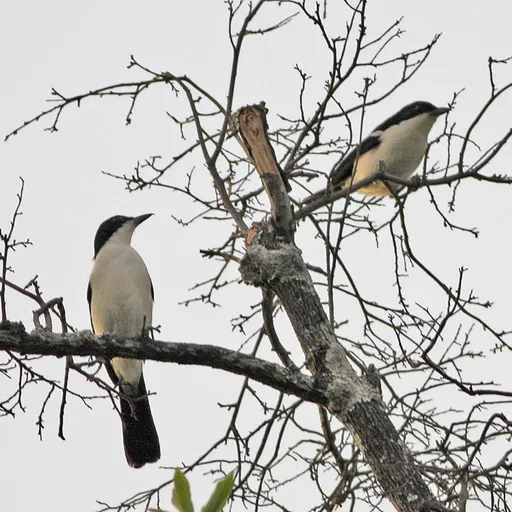
Swamp Boubou
Laniarius bicolor
Least Concern
Overview
The swamp boubou (Laniarius bicolor), also known as the Gabon boubou, is a large passerine bird in the bushshrike family found in western and southern Central Africa. As its name suggests, it is strongly associated with river systems and marshes in the south of its range, while favouring savannah thickets further north.
Identification
- Measures 23 to 25 cm in length with deep blue-black upperparts that have a slight luster.
- Underparts are pure white, while the rump appears pale due to long, fluffy feathers concealing white spots.
- Features a long, slender black bill and slate-blue legs.
- Distinguished from the tropical boubou by its larger size, slender bill, and immaculate white underparts.
Habitat
Native to Angola, Botswana, Cameroon, the Republic of the Congo, DRC, Gabon, Namibia, Zambia, and Zimbabwe, it inhabits regenerating forest, moist to seasonally dry savannah thicket, coastal scrubland, mangroves, and ravine forests. In the southern part of its range, the species is confined to floodplain systems where it frequents dense, tangled riparian vegetation, reedbed edges, papyrus stands, or clumps of water fig on islands.
Diet
Foraging occurs from ground level to the upper canopy, often involving a climb followed by a glide to adjacent vegetation. The bird hawks insects or flicks ground debris like a thrush, feeding on arthropods, worms, and occasionally small fruit.
Did you know?
The female contributes a distinctive harsh, ratchet-like 'kick-ick' note to the pair's duet, which is initiated by a soft guttural sound from either bird.
Sources
- Wikipedia · CC BY-SA 4.0
- Wikidata · CC0 1.0