
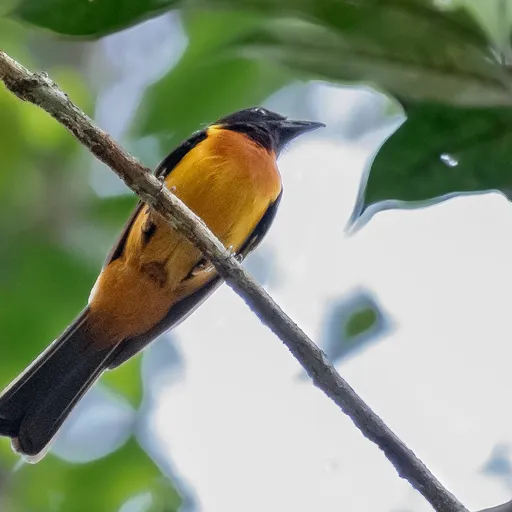
Fulvous Shrike-Tanager
Lanio fulvus
Least Concern
Listen
XC242811 · Niels Krabbe · Morona-Santiago: e-slope Cord. de Cutucú: Uuntsuants, Ecuador · CC BY-SA 4.0
Overview
The fulvous shrike-tanager is a species of bird in the family Thraupidae, found across the northern Amazon Basin and the Guiana Shield in South America. It is a year-round resident of the region and is assessed as being of Least Concern by the IUCN, although its population is believed to be decreasing.
Identification
- A 15 to 17 cm long bird with a shrike-like, hooked bill; the bill is long, black, and toothed.
- Sexually dimorphic plumage: adult males have a black head, throat, wings, and tail, contrasting with a dark yellowish-orange body and dark tawny rufous rump, while females are grey-brown to rufous-brown with a buffy throat.
- Males possess blackish legs, whereas females have legs that are brownish to pinkish grey, and both sexes share a reddish-brown to dark-brown iris.
- The song is described as a lisping, rising series of high, thin whistles interspersed with call notes, sounding like 'wsss-tew' repeated, ending in a piercing 'TCHEW'.
Habitat
The species primarily inhabits intact terra firme forest and occasionally occurs in várzea forest within the northern Amazon Basin and the Guiana Shield. Its distribution spans Brazil, Colombia, Ecuador, French Guiana, Guyana, Peru, Suriname, and Venezuela. It typically occupies lowland elevations, generally ranging below 1,350 m, though this limit varies by country.
Diet
The fulvous shrike-tanager feeds primarily on arthropods, supplemented by some fruit. It forages just under the forest canopy, taking prey disturbed by mixed-species feeding flocks in mid-air and gleaning the remainder from foliage, while taking fruit while perched.
Did you know?
While acting as a sentinel for mixed-species feeding flocks, the bird has been observed giving false alarms to capture prey abandoned by fleeing flock-mates.
Sources
- Wikipedia · CC BY-SA 4.0
- Wikidata · CC0 1.0