
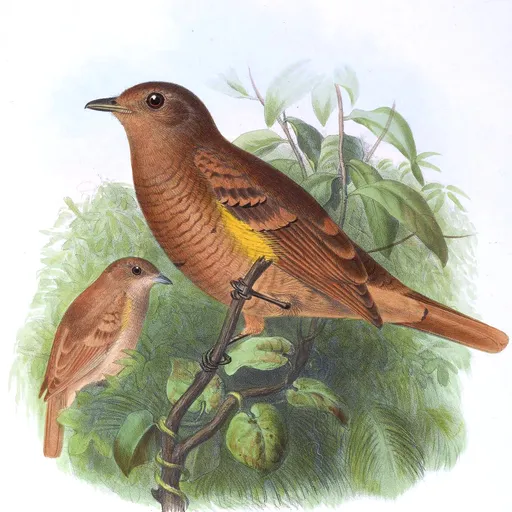
Speckled Mourner
Laniocera rufescens
Least Concern
Listen
XC529178 · Oliver Komar · Wimpi, south of Krausirpi, Departamento de gracias a dios, Honduras · CC BY-SA 4.0
Overview
The speckled mourner is a species of bird in the family Tityridae. It is a year-round resident found in humid evergreen forests across Mexico, Central America, and western Colombia and Ecuador. The species is currently listed as Least Concern by the IUCN.
Identification
- Size and plumage: Measures 19 to 21.5 cm in length; adults feature rufous-brown upperparts and paler cinnamon-brown underparts, with the nominate subspecies displaying a thin orange ring around the eye.
- Wing markings: Dusky wing coverts bear large rufous spots at the tips that form two or three faint wing bars.
- Bill and legs: Possesses a blackish bill with a grayish pink base to the mandible and brownish gray legs.
- Vocalisation: Males produce a ringing, ventriloquial tleeyr that is repeated up to fifteen times, as well as a plaintive, slightly mewing peeeeeeeu that ends abruptly.
Habitat
The species inhabits humid evergreen forests in the tropical zone, often favouring wetter areas near swamps and along streams. Its range extends from northern Oaxaca and Chiapas in Mexico through Central America into Colombia and Ecuador. Elevation typically ranges from sea level to 750 m, though it reaches 1,000 m in Colombia.
Diet
The speckled mourner feeds on arthropods, small lizards, and fruit. Foraging occurs in the understory and midstory of the forest, usually in solitary individuals or occasionally within mixed-species feeding flocks. It forages by perching silently and making short sallies, sometimes with a brief hover, to glean food from foliage or branches.
Did you know?
Early in the nineteenth century, the bird was described as one of the scarcest of Middle American birds, indicating that its rarity was not solely caused by modern-day deforestation. Males also sing with a strikingly ventriloquial quality that can make their location difficult to pinpoint.
Sources
- Wikipedia · CC BY-SA 4.0
- Wikidata · CC0 1.0