
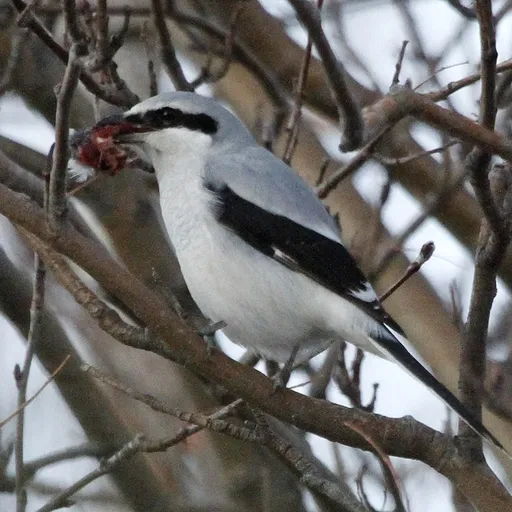
Northern Shrike
Lanius borealis
Least Concern
Overview
The northern shrike (Lanius borealis) is a large songbird in the shrike family, native to North America and Siberia. Formerly regarded as a subspecies of the great grey shrike, it was classified as a distinct species in 2017, with six subspecies currently recognised.
Identification
- Length of 9.1–9.4 in (23–24 cm) and a wingspan of 11.8–13.8 in (30–35 cm).
- Possesses the hooked beak of a raptor, despite being a passerine without talons.
- Distinguished from the similar loggerhead shrike by its larger size, paler plumage, and a black face mask that does not cover the eye completely.
Habitat
The northern shrike breeds in taiga and tundra environments from Labrador west through Alaska to western Siberia and south to parts of China and Mongolia, favouring forest edges with suitable trees or shrubs. During the non-breeding season, it is irruptive, moving south to open country such as prairies, agricultural land, and coastal marshes depending on winter severity and food availability.
Diet
Foraging by perching on tall poles or branches to survey the area, the northern shrike preys on arthropods, small mammals, reptiles, and passerine birds. It has been observed hunting at bird feeders and is known to lure small birds by imitating their calls.
Did you know?
In North America, the bird is commonly known as a butcherbird due to its habit of impaling prey on thorns or spikes, with the Michigan folk name being winter butcherbird.
Sources
- Wikipedia · CC BY-SA 4.0
- Wikidata · CC0 1.0