
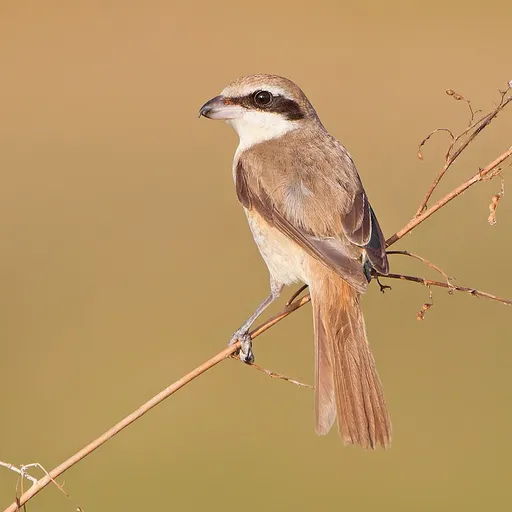
Brown Shrike
Lanius cristatus
Least Concern
Listen
XC1043058 · Ujjal Kishor De · Ambedkar College, fatikroy, Unakoti, Tripura, India · CC BY-SA 4.0
Overview
The brown shrike (Lanius cristatus) is a migratory bird in the shrike family found mainly in Asia, with several distinctive subspecies breeding in temperate regions and wintering in the tropics. It is a member of the Lanius genus, which is named after the Latin word for 'butcher' due to its feeding habits, and its common name derives from the Old English word for 'shriek'.
Identification
- Mainly brown upperparts and a rounded tail, lacking the white 'mirror' patches found in some related species.
- Distinctive black 'bandit-mask' through the eye with a white brow above, which may be paler in winter.
- Creamy underside with rufous flanks and belly, though females exhibit fine scalloping and a less distinct dark brown mask.
- Vagile movements while singing, with the beak remaining closed and visible throat pulsations, often mimicking other birds.
Habitat
This species inhabits open scrub and perches on thorny bushes across a range from taiga and forest to semi-desert environments. It breeds in temperate Asia, including Mongolia, Siberia, and parts of Japan and China, before migrating to winter quarters in tropical Asia such as South Asia, Myanmar, and the Malay Peninsula.
Diet
Primarily an insectivore with a preference for Lepidoptera, the brown shrike also preys on small birds and lizards. It forages by scanning from a perch and diving to the ground to capture prey, which it then impales on thorns or stores in a larder, similar to other shrike species.
Did you know?
The species' English name 'shrike' originates from the Old English 'scríc', meaning 'shriek', a direct reference to its shrill vocalisations. Its winter song is unique in that the beak remains closed while the bird sings, with only throat pulsations visible as it moves its tail up and down.
Sources
- Wikipedia · CC BY-SA 4.0
- Wikidata · CC0 1.0