
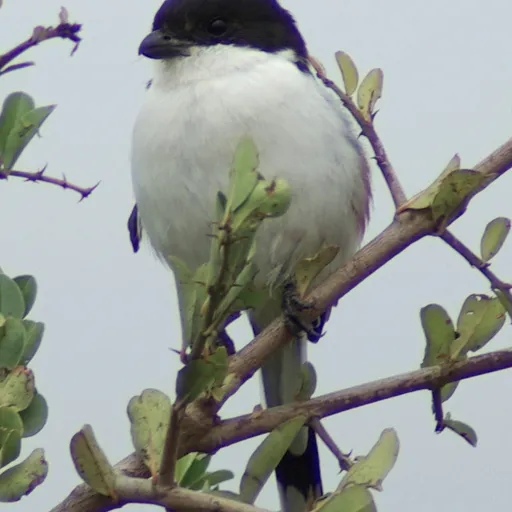
Northern Fiscal
Lanius humeralis
Listen
XC605753 · paulo kivuyo · Engare Nanyuki, Arusha Rural, Arusha Region, Tanzania · CC BY-SA 4.0
Overview
The northern fiscal, Lanius humeralis, is a member of the shrike family found throughout most of Sub-Saharan Africa. It derives its English and Afrikaans common names from its black and white 'suit-and-tie' appearance, which resembles that of a taxman. Previously grouped with the southern fiscal as the common fiscal, it is now recognised as a distinct species.
Identification
- A distinctive 21–23 cm passerine with white underparts and black upperparts extending from the top of the head to the tail.
- Features a characteristic white 'V' on the back and a long black tail with white outer feathers and white tips on the other feathers.
- Bill, eyes and legs are black, with adult females distinguished by rufous lower flanks.
- Vocalisations include a jumbled mix of shrike-like swizzling sounds, some imitations, and a harsh 'Dzzzttt-dzzzt-dzzzt' alarm call.
Habitat
The species inhabits a wide range of environments, including grassland with fences, acacia thornveld and woodland, while avoiding very dense habitats that would impair its hunting. Its range covers most of Sub-Saharan Africa, with subspecies distributions extending from Mauritania and the West African coast across to the Horn of Africa, Tanzania, Malawi and Mozambique.
Diet
The northern fiscal is usually solitary and hunts insects and small rodents from exposed perches or the tops of shrubs. Its territorial size is directly related to the density of hunting perches, with the addition of artificial perches allowing the bird to reduce its territory and accommodate more individuals in the area.
Did you know?
The bird's common name, 'fiscal', stems from a visual pun on its black and white 'suit-and-tie' plumage, which was noted to resemble the appearance of a taxman in Afrikaans and English contexts.