
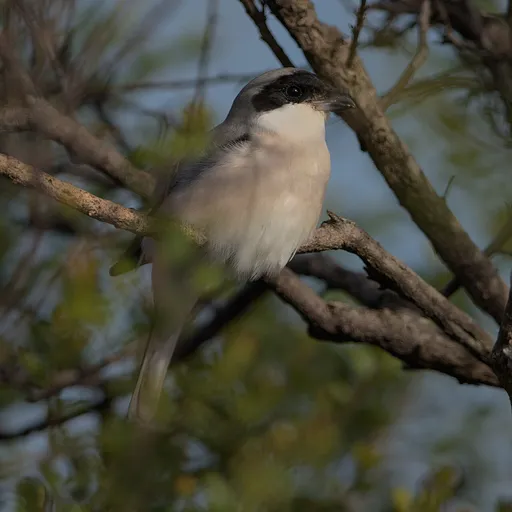
Lesser Grey Shrike
Lanius minor
Least Concern
Overview
The lesser grey shrike (Lanius minor) is a medium-sized passerine bird in the shrike family Laniidae. It breeds in South and Central Europe and western Asia before migrating to winter quarters in tropical southern Africa. The species is classified as Least Concern on the IUCN Red List.
Identification
- Males feature a black nape, cheeks, ear and eye coverts, and front part of the crown, with a pale bluish-grey back and white underparts suffused with pink on the lower breast and belly.
- Females resemble males but have a dark grey head, brownish-grey upperparts, and less pink underparts; juveniles are browner with pale brown, faintly barred backs.
- Distinguished from the great grey shrike by its slightly smaller size, black forehead, and relatively longer wings.
- Adults measure around 20 cm in length with a 13 cm wing length, possessing a brownish-black beak with a paler lower mandible base, brown irises, and black legs.
Habitat
Breeding occurs in open countryside, heathland with scattered bushes, and the edges of cultivated areas across South and Central Europe and western Asia. In its winter range across tropical southern Africa, the bird prefers scrubland and thorn trees. It is a scarce vagrant to western Europe, including Great Britain, usually appearing as a spring or autumn erratic.
Diet
The lesser grey shrike primarily feeds on large insects such as beetles, butterflies, moths, grasshoppers, and crickets, occasionally consuming fruits like cherries and figs. It hunts from prominent perches or by hovering in the air on breeding grounds, though it does not hover while moulting on non-breeding grounds. It occasionally impales prey on thorns as a larder, but this is rare due to infrequent food surpluses.
Did you know?
Experimental evidence indicates that lesser grey shrikes only create a food larder when they are satiated, a condition that is seldom naturally occurring because prey items are rarely plentiful enough to trigger hoarding behaviour.
Sources
- Wikipedia · CC BY-SA 4.0
- Wikidata · CC0 1.0