
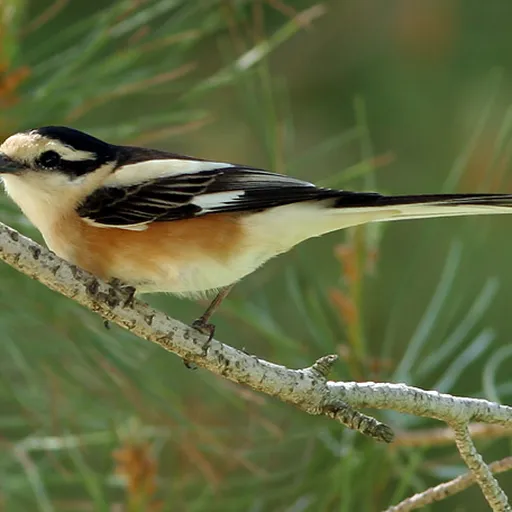
Masked Shrike
Lanius nubicus
Least Concern
Overview
The masked shrike (Lanius nubicus) is the smallest member of its genus, characterised by a long tail and a hooked bill with unique tomial teeth. It breeds in southeastern Europe and western Asia, migrating to winter in northeast Africa, and is currently classified as a species of least concern.
Identification
- Males feature mainly black upperparts with a white crown, forehead, and supercilium, plus large white patches on the shoulders and wings.
- Underparts are white with orange on the flanks and breast, while females present a duller version with brownish-black upperparts.
- A slender, long-tailed bird that perches upright and frequently cocks its tail.
- Song is soft for a shrike, consisting of chattering sounds interspersed with rich warbles that resemble those of olive-tree warblers.
Habitat
This species prefers open woodland with bushes and some large trees, avoiding very open country and perching in less exposed locations than its relatives. It occurs in lowlands and hills up to 1,000 m, and in some areas breeds at greater altitudes up to 2,000 m. Orchards and cultivated land with suitable old trees or large hedges are also utilised.
Diet
Feeding mainly on large insects, it occasionally consumes small vertebrates, sometimes using an agile flycatcher-like flight to catch prey in the air. The bird is known to impale its prey on thorns or barbed wire as a larder for immediate or later consumption, a behaviour practised by both sexes in various seasons.
Did you know?
The upper mandible bears a triangular ridge that fits a corresponding notch in the lower mandible to separate prey, an adaptation otherwise found only in falcons.
Sources
- Wikipedia · CC BY-SA 4.0
- Wikidata · CC0 1.0