
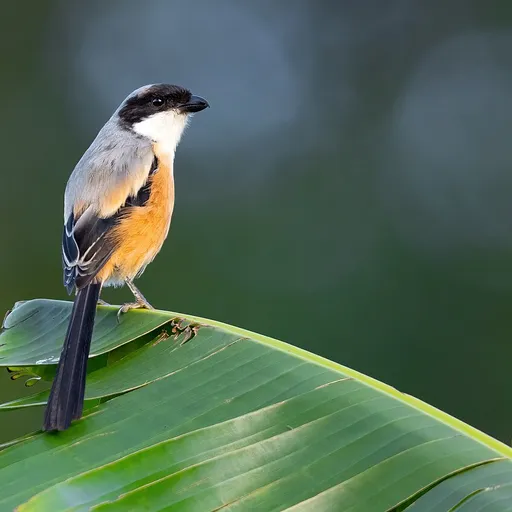
Long-tailed Shrike
Lanius schach
Least Concern
Overview
The long-tailed shrike, also known as the rufous-backed shrike, is a bird of the family Laniidae found widely distributed across Asia. It is a typical shrike that favours dry open habitats and is characterised by a long, narrow black tail. The species exhibits considerable plumage variation among its nine recognised subspecies across the mainland and eastern archipelagos.
Identification
- All subspecies possess a long, narrow black tail that is graduated with pale rufous on the outer feathers.
- Features a broad black mask through the eye that covers the forehead, with the whole head being black in the tricolor and nasutus subspecies.
- Displays rufous rump and flanks, with a small white patch on the shoulder and a small amount of white at the base of the primaries.
- Vocalisations include harsh, grating calls likened to a squealing frog, as well as the ability to mimic the calls of other birds such as lapwings and cuckoos.
Habitat
The species ranges across much of Asia from Kazakhstan to New Guinea, inhabiting scrub, grassland, and open land under cultivation. Temperate populations are migratory, moving south in winter, while tropical populations tend to be sedentary. In southern India, the caniceps subspecies is found in the dry coastal zone during winter.
Diet
Long-tailed shrikes forage by gliding down from prominent perches to catch lizards, large insects, small birds, rodents, and occasionally fish or small snakes. They practise kleptoparasitism, stealing prey from other birds, and sometimes impale prey on thorny bushes after consuming the head or brain. They have also been observed feeding on the fruits of the neem tree.
Did you know?
Due to their capability in vocal mimicry, which includes the sounds of puppies and squirrels, long-tailed shrikes are popular pets in parts of Southeast Asia. They also display social play behaviour, with individuals fighting over perches despite maintaining solitary feeding territories.
Sources
- Wikipedia · CC BY-SA 4.0
- Wikidata · CC0 1.0