
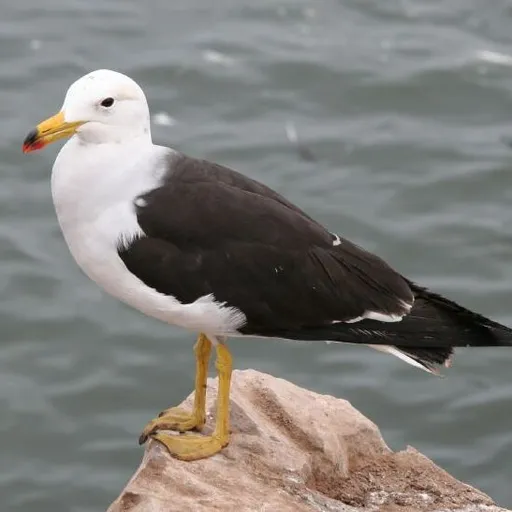
Belcher's Gull
Larus belcheri
Least Concern
Overview
Larus belcheri, commonly known as Belcher's gull or the band-tailed gull, is a medium-sized gull in the family Laridae. It is a non-migratory species native to the Pacific coast of South America, where it occupies rocky shores, bays, and offshore islands within the influence of the Humboldt Current.
Identification
- Medium-sized gull measuring 48–54 cm in length with a wingspan of approximately 120 cm.
- Breeding adults feature a white head, pale grey neck, white underparts, and a greyish-black mantle, with a distinctive white tail bearing a broad black subterminal band.
- Possesses a yellow bill with a unique red and black tip, which helps distinguish it from the kelp gull.
- Non-breeding adults display a dark brown head accompanied by a prominent white eye-ring.
Habitat
Found along the Pacific coast of South America, specifically from northern Peru to northern Chile in the area influenced by the Humboldt Current. It inhabits rocky shores, bays, and offshore islands, often venturing several kilometres offshore to forage or feeding on rocky shores when the tide is out.
Diet
An omnivore and scavenger that feeds on fish, crabs, molluscs, and carrion, and seasonally consumes the eggs and nestlings of seabirds. It frequently associates with Guanay cormorants, pestering them until they regurgitate their prey for the gull to consume.
Did you know?
The species is named after Sir Edward Belcher, a British explorer who conducted survey work on the Pacific coast of South America. Its total population is estimated at under ten thousand individuals, yet it is considered to be of 'least concern' by the IUCN due to increasing numbers and diminished human persecution.
Sources
- Wikipedia · CC BY-SA 4.0
- Wikidata · CC0 1.0