
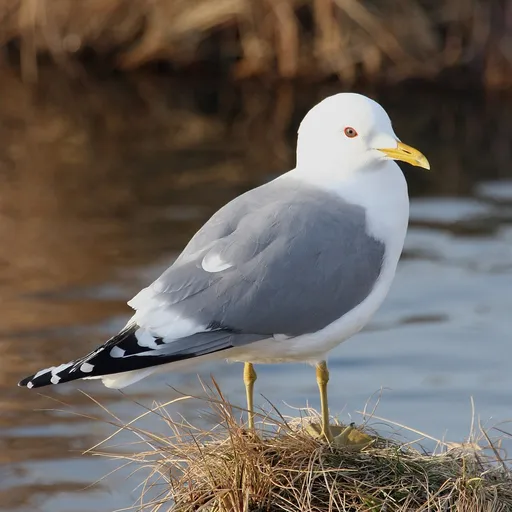
Short-billed Gull
Larus brachyrhynchus
Overview
The Larus brachyrhynchus is a species of gull that was previously known as the mew gull when it was considered part of the Palearctic common gull. Most authorities, including the American Ornithological Society in 2021, now recognise it as a distinct species based on genetic, morphological, and vocal differences.
Identification
- Smaller than other gulls in the common gull complex, with a length of 40–45 cm, a shorter bill, and long, narrow wings.
- Breeding adults feature a white head, pale eyes surrounded by red orbital skin, and a yellow bill and legs with no markings.
- Winter plumage includes brown mottling on the head, greyish orbital skin, and a duller bill with a faint dark marking.
- In flight, the two outermost primary feathers show conspicuous white 'mirrors', while p5 to p8 display white 'tongue tips' forming a string of pearls.
Habitat
This species breeds in colonies along coastal areas and inland wetlands, primarily in Alaska and Northwest Canada. Most populations winter along the Pacific coast as far south as the Sacramento Valley, with occasional presence in Baja California, the Northern Rockies, and Ontario. It is a very rare visitor to eastern North America and has been recorded as a vagrant in Europe and east Asia.
Did you know?
Short-billed gulls require three years to attain their full breeding plumage, a period during which their appearance changes significantly from brownish juveniles to near-adults.