
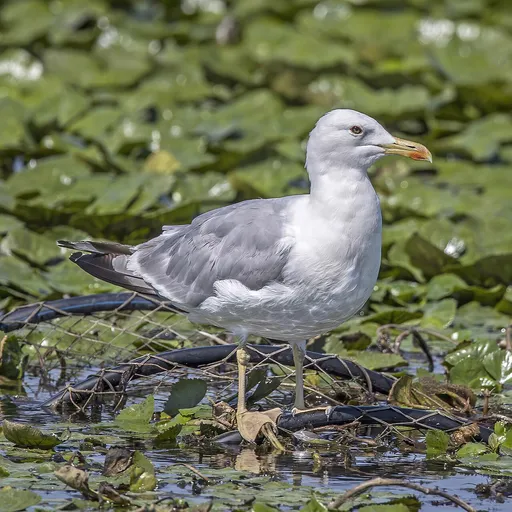
Caspian Gull
Larus cachinnans
Least Concern
Listen
XC815471 · Sonothèque ADVL · Pont de la Pesrelle (Cuves), Manche, Normandie, France · CC0 1.0
Overview
The Caspian gull (Larus cachinnans) is a large gull that belongs to the herring and lesser black-backed gull complex. Its scientific name derives from the Latin word cachinnans, meaning 'laughing'.
Identification
- Large gull measuring 56–68 cm in length with a wingspan of 137–155 cm and a body mass of 680–1,590 g.
- Long, slender bill accentuated by a sloping forehead, with legs and wings longer than those of the herring gull.
- Back and wings are a slightly darker shade of grey than the herring gull but paler than the yellow-legged gull.
- Outermost primary feather features a large white tip and a white tongue running up the inner web.
Habitat
Breeding occurs around the Black and Caspian Seas, extending eastwards across Central Asia to north-west China. The species is spreading north and west in Europe, breeding in Poland, eastern Germany, southern Russia, and Ukraine. Small numbers are now seen regularly in Britain, particularly in South-east England, East Anglia, and the Midlands.
Diet
They are scavengers and predators with a very varied diet. During the breeding season, they often eat rodents such as ground squirrels, flying some distance into the steppes to find them.
Did you know?
The scientific name Larus cachinnans includes the word cachinnans, which means 'laughing'.
Sources
- Wikipedia · CC BY-SA 4.0
- Wikidata · CC0 1.0