
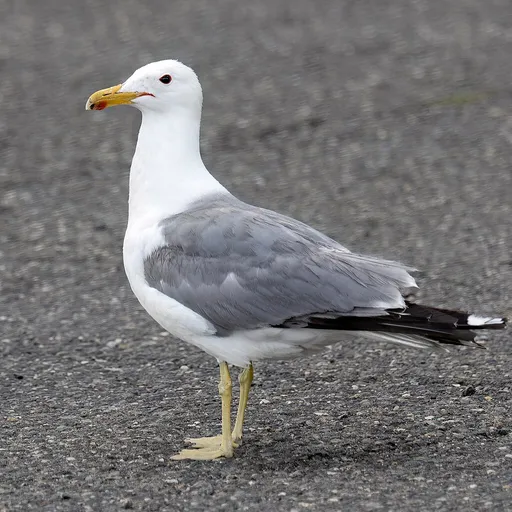
California Gull
Larus californicus
Least Concern
Overview
The California gull (Larus californicus) is a medium-sized gull that is smaller on average than the herring gull but larger than the ring-billed gull. Despite its name, it is found annually across most of western North America.
Identification
- Adults have a mainly white body with a grey back and upper wings, brown eyes, and yellow legs.
- The bill is yellow featuring a black ring and a red spot near the tip.
- Black primaries with white tips are visible in the wings.
- Length ranges from 46 to 55 cm, with a wingspan of 122–137 cm.
Habitat
Breeding habitats consist of lakes and marshes in interior western North America, ranging from the Northwest Territories in Canada down to eastern California and Colorado. These birds are migratory, moving to the Pacific coast in winter, where they are regularly found in western California.
Diet
These opportunistic feeders forage in flight or while swimming, walking, or wading, primarily consuming insects, fish, and the eggs and young of other birds. They also eat vegetables and fruits, particularly cherries, and frequently scavenge at garbage dumps, marinas, and docks.
Did you know?
The California gull is the state bird of Utah, remembered for assisting Mormon settlers in dealing with a plague of Mormon crickets, an event known as the 'Miracle of the Gulls'.
Sources
- Wikipedia · CC BY-SA 4.0
- Wikidata · CC0 1.0