
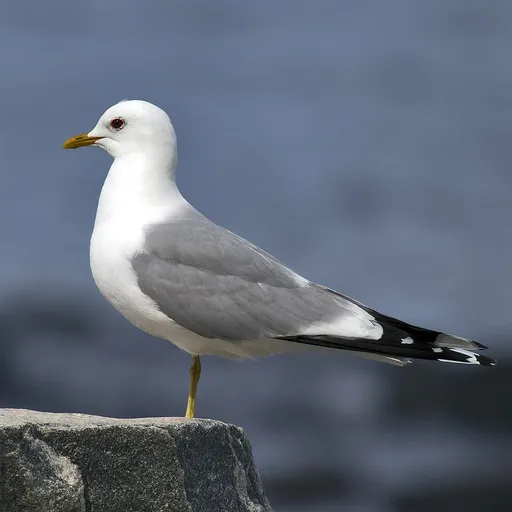
Common Gull
Larus canus
Least Concern
Listen
XC1079679 · Sonothèque ADVL · Marais de la Claire-Douve,Dragey-Ronthon, Manche, Normandie, France · CC0 1.0
Overview
The common gull (Larus canus) is a seabird that breeds in cool temperate regions of the Palearctic. It was formerly often grouped with the closely related short-billed gull under the collective name 'mew gull'.
Identification
- Adults measure 40–46 cm in length with a wingspan of 100–115 cm and a body that is grey above and white below.
- The bill is shorter and more tapered than that of the herring gull, appearing in a greenish shade of yellow and unmarked during the breeding season.
- Black wingtips feature large white 'mirrors' on the outer primaries, while the head becomes streaked grey in winter.
- The call is described as a high-pitched 'laughing' cry.
Habitat
The species breeds in the northern Palearctic, ranging from Iceland and Scotland east to Kamchatka in the Russian Far East. Most populations migrate to winter in the Mediterranean, the southern Caspian Sea, and the seas around China and Japan, although northwest European populations are at least partly resident.
Diet
As an omnivore, the common gull scavenges and hunts small prey, similar to most other gull species.
Did you know?
The original English word 'mew' is ultimately onomatopoeic and is related to German 'möwe' and Dutch 'meeuw'.
Sources
- Wikipedia · CC BY-SA 4.0
- Wikidata · CC0 1.0