
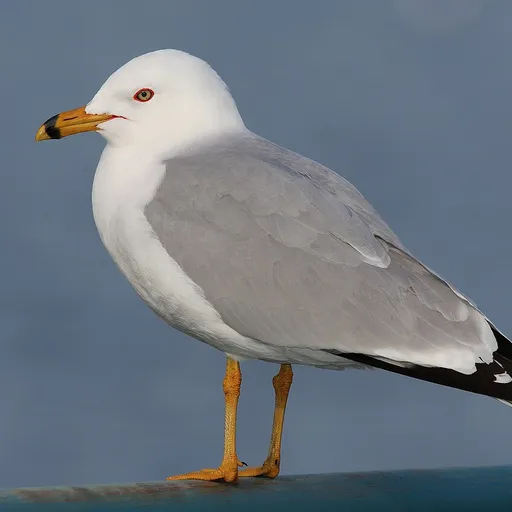
Ring-billed Gull
Larus delawarensis
Least Concern
Overview
The ring-billed gull is a medium-sized gull native to North America that breeds in Canada and the northern United States before wintering in the southern US and Mexico. It is the most common gull in eastern North America and is classified as Least Concern by the IUCN Red List.
Identification
- White head, neck, and underparts with a silver-grey back and wings featuring black wingtips with white 'mirrors'.
- A relatively short yellow bill with a distinct black ring, along with yellow legs.
- Yellow eyes surrounded by red rims.
- Medium-sized build averaging 43 to 54 cm in length with a wingspan of 105 to 117 cm.
Habitat
Breeding habitat consists of areas near lakes, rivers, or the coast across Canada and the northern United States, where the birds nest colonially on the ground or on factory roofs. In winter, most migrate to the Gulf of Mexico and the Atlantic and Pacific coasts of the United States and northern Mexico. They are frequently observed in North American parking lots, beaches, marinas, and docks.
Diet
These omnivorous birds forage in flight or by walking, wading, or swimming, and often scavenge or steal food from other birds. Their diet includes insects, fish, grain, eggs, earthworms, and rodents. They have adapted well to urban environments, readily taking food left unattended by people.
Did you know?
The ring-billed gull is a regular wanderer to western Europe, where it is no longer considered a rarity in Ireland and Great Britain, though its numbers have declined significantly since the 1990s. This pattern contrasts with the Bonaparte's gull, another transatlantic visitor, which has seen an increase in Great Britain over the same period.
Sources
- Wikipedia · CC BY-SA 4.0
- Wikidata · CC0 1.0