
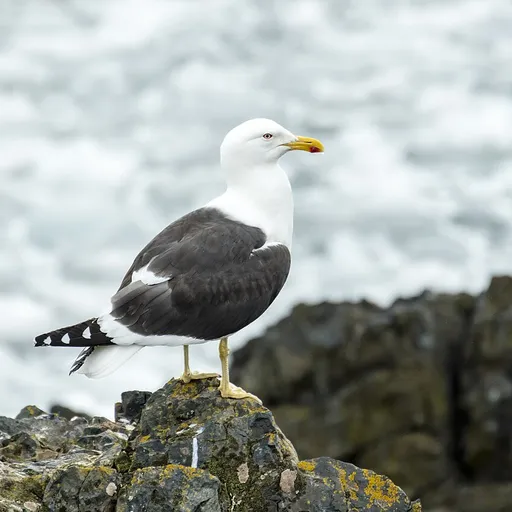
Kelp Gull
Larus dominicanus
Least Concern
Overview
The kelp gull (Larus dominicanus), also known as the Dominican gull, is a large gull that breeds on coasts and islands through much of the Southern Hemisphere. It is classified as Least Concern on the IUCN Red List.
Identification
- Adult birds feature black upper parts and wings, contrasting with white heads, underparts, and tails, along with small white "mirrors" at the wing tips.
- The bill is yellow with a red spot, while the legs are greenish-yellow, appearing brighter and yellower during the breeding season.
- Size ranges from 54 to 65 cm in length with a wingspan of 128 to 142 cm, placing it intermediate between the lesser and great black-backed gulls.
- The call is described as a strident ki-och.
Habitat
This species inhabits coastal and island environments across the Southern Hemisphere, including South America, parts of Australia, New Zealand, and Southern Africa. It has been recorded as a rare vagrant in the United States, with sightings in Louisiana and Milwaukee, Wisconsin.
Diet
Kelp gulls are omnivores that scavenge on landfills and seek small prey, often gathering in large numbers where a sharp increase in population can indicate a degraded environment. They have been observed pecking into the skin and blubber of living right whales and dropping shellfish from the air to break them open. In Namibia, they have also been reported pecking the eyes out of seal pups before attacking the blind animals.
Did you know?
The specific name dominicanus derives from the Dominican Order of friars, who traditionally wear black and white habits. In 2025, a kelp gull was found living on the roof of a warehouse in Milwaukee, Wisconsin, and had apparently returned to the same site by April 2026.
Sources
- Wikipedia · CC BY-SA 4.0
- Wikidata · CC0 1.0