
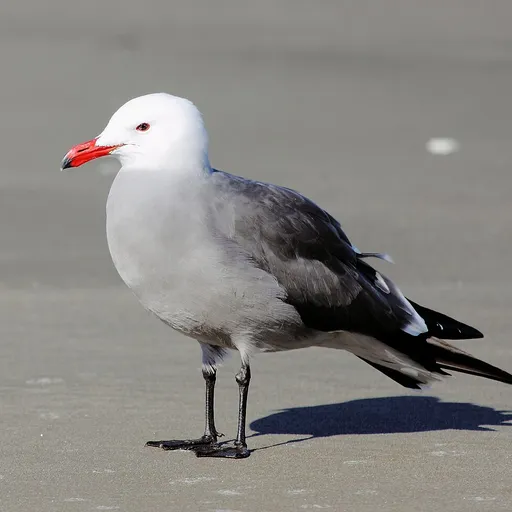
Heermann's Gull
Larus heermanni
Near Threatened
Overview
Heermann's gull (Larus heermanni) is a gull resident in the United States, Mexico, and extreme southwestern British Columbia, nearly all nesting on Isla Rasa in the Gulf of California. The species is classified as Near Threatened by the IUCN due to its vulnerability to catastrophic weather events and dependence on specific prey availability influenced by ocean temperature changes.
Identification
- Adults feature a medium gray body with blackish-gray wings and tail edged in white, and a red bill with a black tip.
- The head appears dusky gray in non-breeding plumage but turns white during the breeding season.
- It is the only white-headed, gray-bodied gull found on the west coast of North America, making it distinct from similar species.
- Calls are deep and similar in pattern to other gulls but noticeably different in quality.
Habitat
The species is usually found near shores or well out to sea, very rarely inland. Approximately 90% of the population nests on the island of Isla Rasa off Baja California, with smaller colonies ranging from California to Nayarit, and birds dispersing post-breeding as far north as British Columbia and south as Guatemala.
Diet
Heermann's gull eats small fish, marine invertebrates, lizards, insects, and carrion. It sometimes steals prey from other seabirds, particularly brown pelicans, with which it often associates.
Did you know?
A one-legged gull demonstrated strong site fidelity by residing for 17 years at the Loch Lomond Marina in San Rafael, California. Additionally, a breeding colony in Seaside, California, once nested on a rooftop after their nesting island eroded, and later saw a nesting site destroyed by a drunk driving crash at a local McDonald's.
Sources
- Wikipedia · CC BY-SA 4.0
- Wikidata · CC0 1.0