
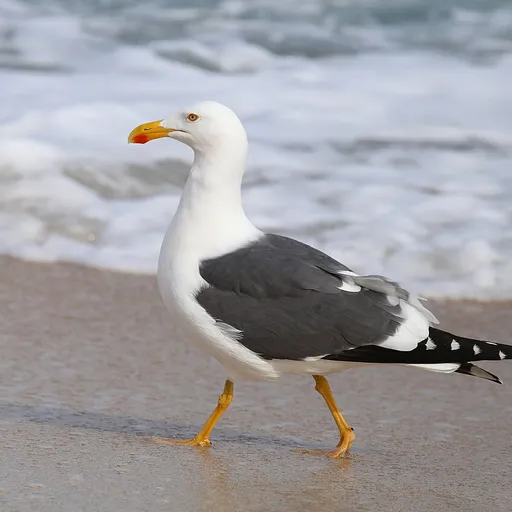
Yellow-footed Gull
Larus livens
Least Concern
Overview
The yellow-footed gull (Larus livens) is a large gull closely related to the western gull, which was previously considered a subspecies until the 1960s. It is endemic to the Gulf of California in Mexico and is classified as a species of Least Concern by the IUCN.
Identification
- Adults feature a white head, dark slate-colored back and wings, and a thick yellow bill.
- Legs are yellow, though first-winter birds display pink legs.
- It is one of the largest gull species in the world, measuring 53 to 72 cm in length with a wingspan of 140 to 160 cm.
Habitat
Native to the Gulf of California, this species primarily inhabits sandy and rocky coasts or islands with little vegetation. Most individuals are non-migratory, but an increasing number travel to the Salton Sea in California and Sonora during non-breeding periods.
Diet
These birds act as scavengers and foragers, feeding on small fish, invertebrates, carcases of marine mammals, and offal. They also prey on seabird chicks and eggs, including pelican eggs, and occasionally scavenge around waste dumps and docks.
Did you know?
The yellow-footed gull is tied with the slaty-backed gull for the distinction of being the world's fourth-largest gull species.
Sources
- Wikipedia · CC BY-SA 4.0
- Wikidata · CC0 1.0