
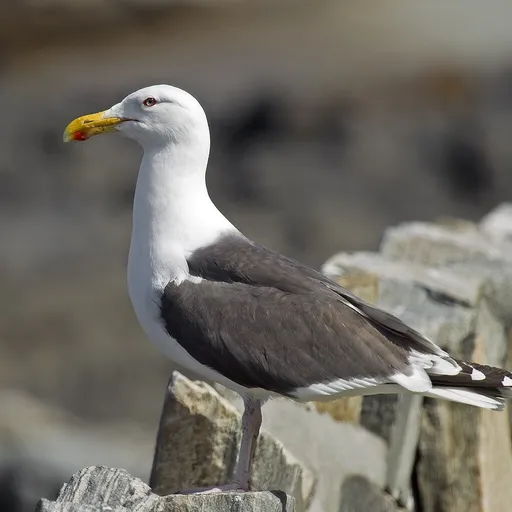
Great Black-backed Gull
Larus marinus
Least Concern
Listen
XC730806 · Sonothèque ADVL · Tombelaine, Manche, Normandie, France · CC0 1.0
Overview
The great black-backed gull (Larus marinus) is the largest member of the gull family, Laridae, characterised as a bulky, aggressive hunter and scavenger. It breeds along the North Atlantic coasts of northern Europe and northeastern North America, with southern populations generally remaining sedentary.
Identification
- Plumage: Adults possess a white head, neck and underparts, contrasting with dark blackish-grey wings and back, featuring conspicuous white 'mirrors' at the wing tips.
- Size: Considerably larger than a herring gull, measuring 64–79 cm in length with a wingspan of 1.5–1.7 m.
- Bill and Legs: Features a large, powerful yellow or yellow-pink bill with red or orange near the tip, paired with pinkish legs.
- Voice: Produces a deep, 'laughing' cry described as kaa-ga-ga, distinctly deeper than that of most other gull species.
Habitat
Found in coastal areas ranging from the northwest of Russia and Scandinavia to the Atlantic coasts of North America, including islands such as Iceland and the Faroes. The species utilises diverse habitats such as rocky and sandy coasts, estuaries, inland wetlands, and refuse dumps, often breeding in areas inaccessible to terrestrial predators like vegetated islands or building roofs.
Diet
An opportunistic feeder and apex predator, this gull consumes fish, crustaceans, molluscs, and occasionally other birds, relying on physical strength and aggression to hunt or pirate prey from other species. It also heavily exploits human refuse, with garbage constituting a significant portion of its diet in some regions.
Did you know?
In one observation, a third-year great black-backed gull was seen fighting an adult female northern goshawk off its kill, while the raptor attempted to strike the gull in self-defence.
Sources
- Wikipedia · CC BY-SA 4.0
- Wikidata · CC0 1.0