
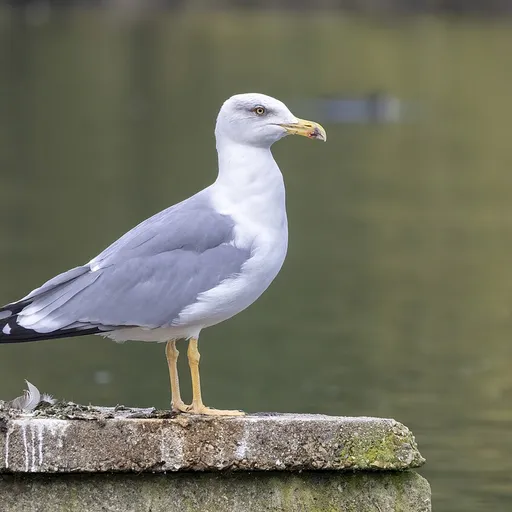
Yellow-legged Gull
Larus michahellis
Least Concern
Listen
XC624044 · Giovanni Francesco Tartarelli · Livorno, Provincia di Livorno, Toscana, Italy · CC BY 4.0
Overview
The yellow-legged gull (Larus michahellis) is a large gull found in Europe, the Middle East, and North Africa that has recently achieved wide recognition as a distinct species. Previously considered a subspecies of the Caspian or herring gull, it is now generally accepted as a full species, with DNA research indicating it is closest to the great black-backed gull and the Armenian gull.
Identification
- Adults have a grey back, slightly darker than herring gulls but lighter than lesser black-backed gulls, and feature yellow legs.
- They possess a red spot on the bill and a red ring around the eye, unlike herring gulls which have a dark yellow eye ring.
- In autumn, they appear much whiter-headed than herring gulls and have extensively black wing tips with few white spots.
- The call is a loud laugh that is deeper and more nasal than that of the herring gull.
Habitat
The breeding range is centred on the Mediterranean Sea, extending to North Africa, the Middle East, and parts of Europe including the Atlantic coasts and islands. While many birds remain resident year-round, others migrate to western Europe or as far south as Senegal and the Red Sea for the winter. In the western Black Sea, the species prefers sea cliffs, distinguishing it from the Caspian gull which favours flatter shores.
Diet
Omnivorous and opportunistic, these gulls scavenge on rubbish tips, forage in fields or on the coast, and rob smaller seabirds of their catches. Urban populations can shift to a predatory diet when necessary, taking prey as large as rats and rock doves during periods of food scarcity. They may also feed by taking fish remains in harbours, showing little overlap with fishing vessels in some populations.
Did you know?
During the 2020 lockdown in Italy, yellow-legged gulls in Rome shifted from scavenging to predation, catching prey as large as rats and rock doves due to a lack of food scraps. Atlantic gulls in Gibraltar have also been observed picking and eating fruit from olive trees while in flight.
Sources
- Wikipedia · CC BY-SA 4.0
- Wikidata · CC0 1.0