
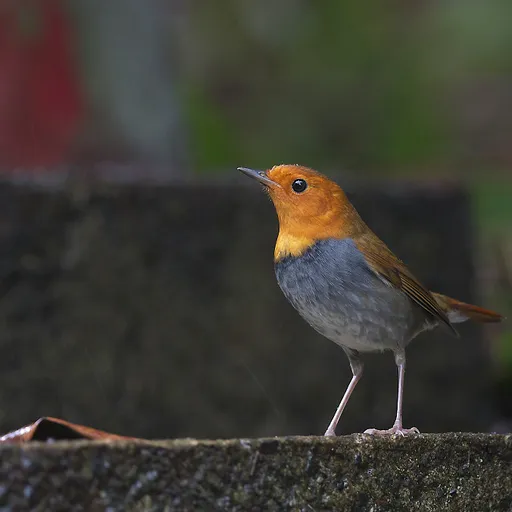
Japanese Robin
Larvivora akahige
Least Concern
Overview
The Japanese robin, Larvivora akahige, is a small passerine bird in the family Muscicapidae formerly known as Erithacus akahige or Komadori. It is an abundant species across the islands of Japan and is classified as Least Concern on the IUCN Red List.
Identification
- Approximately 14-15 cm in size, featuring a mainly grey and bright orange plumage.
- Males display olive-brown upperparts from head to rump, an orange face and neck, a grey breast and underside, a reddish-brown tail, pinkish-brown legs, and a black bill.
- Females resemble males but possess duller and less extensive orange and brown coloration, while juveniles exhibit dark breast spotting and pale rufous feathers.
- The song begins extremely loud before toning down, resembling a well-spaced telephone ring with short chattering.
Habitat
This species inhabits damp, dense, and shady areas such as undergrowth along valleys and streams, as well as broadleaf and deciduous forests. Its range extends from the south of the Kuril and Sakhalin Islands throughout Japan, with winters spent in Southeast Asia.
Diet
As its scientific name meaning "caterpillar eater" suggests, the Japanese robin feeds on beetles, milled worms, small crickets, and other small insects, along with fruits. It is considered omnivorous and relies on habitats abundant with small insects and plants.
Did you know?
The specific name akahige is somewhat confusingly the common name of its relative Larvivora komadori in Japanese. Additionally, the population on the Izu Islands is so geographically remote that they are usually considered a distinguishable subspecies, L. akahige tanensis, with rare gene flow leading to common inbreeding.
Sources
- Wikipedia · CC BY-SA 4.0
- Wikidata · CC0 1.0