
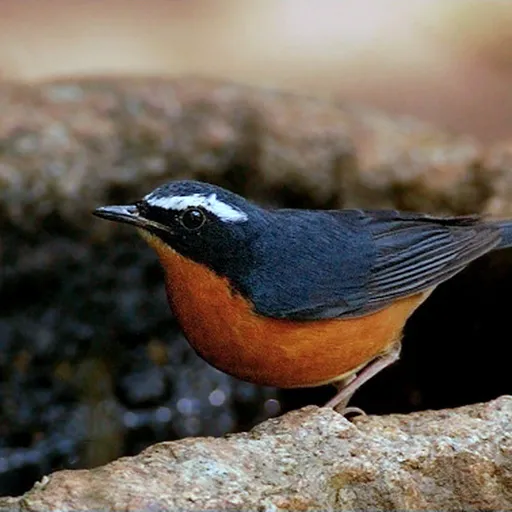
Indian Blue Robin
Larvivora brunnea
Least Concern
Overview
The Indian blue robin (Larvivora brunnea) is a small migratory bird found in the Indian subcontinent, formerly classified as a thrush but now recognised as an Old World flycatcher in the family Muscicapidae. It breeds in Himalayan forests and winters in the hill forests of the Western Ghats and Sri Lanka.
Identification
- Adult males have blue upperparts and rufous underparts, featuring a bright white supercilium that contrasts with a black mask extending down the neck, and whitish lower belly and undertail.
- Females are olive brown above and buff below with a light eye-ring, rufescent rump, and buffy breast and flanks.
- Young birds are dark brown with buff spots.
- Approximately 15 cm long, similar in size to the bluethroat.
Habitat
This species typically inhabits dense, dark forest with undergrowth and leaf litter. It breeds in the forests along the Himalayas of Nepal, India, Myanmar and Bangladesh, and winters in the hill forests of the Western Ghats in India and in Sri Lanka.
Diet
The Indian blue robin is insectivorous and feeds mainly on the ground. It forages by skulking in undergrowth and hopping on the ground, frequently flicking and fanning its tail.
Did you know?
The European cuckoo (Cuculus canorus) has been recorded in old literature as a brood parasite of this species.
Sources
- Wikipedia · CC BY-SA 4.0
- Wikidata · CC0 1.0