
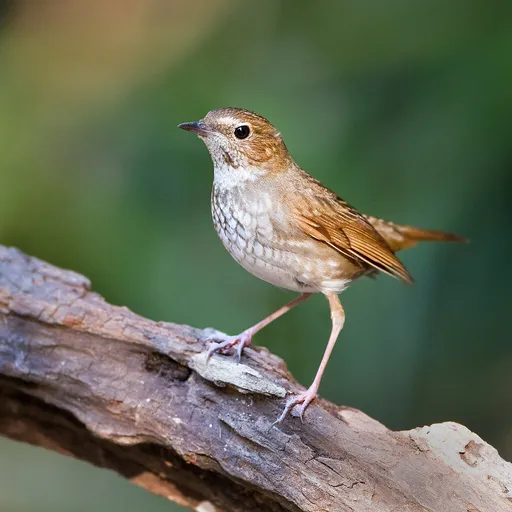
Rufous-tailed Robin
Larvivora sibilans
Least Concern
Overview
The rufous-tailed robin (Larvivora sibilans) is a small passerine bird known by various names, including Swinhoe's red-tailed robin and whistling nightingale. It is a migratory insectivorous species that breeds in the taiga of northeastern Asia and winters in Southeast Asia and southern China. The species is currently assessed as Least Concern by the IUCN.
Identification
- Size comparable to the European robin at approximately 14 cm in length.
- Plain greyish brown upperparts and grey to white underparts, featuring a bright rufous rump and tail.
- Heavily mottled throat and breast with circular pale markings, alongside a whitish eye ring and pronounced buffish cheek stripe.
- Song consists of loud cascading trills starting at a high pitch and ending lower, described as being similar to the neigh of a horse.
Habitat
Breeds in coniferous woodlands and damp broad-leafed woodland with thick undergrowth, particularly in spruce, fir, willow, alder, birch, poplar, and bird cherry environments. It is mainly a lowland species but can occur at altitudes up to 1,200 m. In winter quarters, it inhabits forests, areas with scattered trees, scrubland, parks, and gardens.
Diet
This terrestrial and insectivorous species feeds mainly on ants, beetles, spiders, and other invertebrates. It is described as an elusive bird that forages among concealing branches, remaining stationary for considerable periods while actively flicking its tail in a characteristic manner.
Did you know?
Despite being a species native to Asia, it is a rare vagrant to Western Europe, with records from Fair Isle in 2004, Poland in 2006, England in 2011 and 2013, and Denmark in 2012. The species name sibilans derives from Latin, meaning 'whistling'.
Sources
- Wikipedia · CC BY-SA 4.0
- Wikidata · CC0 1.0