
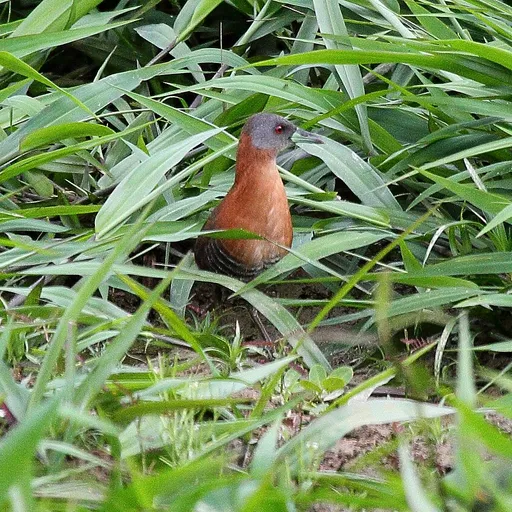
White-throated Crake
Laterallus albigularis
Least Concern
Overview
The white-throated crake (Laterallus albigularis) is a small rail found across Central and South America. It is classified as Least Concern by the IUCN Red List.
Identification
- Length of 14 to 16 cm with sexes being alike, males weighing approximately 50 g and females 45 g.
- Nominate subspecies exhibit a white throat and upper breast, rufous face and lower breast, olive brown upperparts, and black-and-white barred underparts.
- Subspecies variation includes a grey face in L. a. cinereiceps and an entirely rufous head and throat in L. a. cerdaleus.
- Vocalisations include an abrupt, explosive descending trill or churr, with a sharp 'chip' as an alarm call.
Habitat
This species occupies a wide range of habitats, from wet marshes and grassy fields to dry thickets, forest clearings, and watercourse edges. It inhabits elevations from sea level up to 1,600 m. Its distribution covers Colombia, Costa Rica, Ecuador, Honduras, Nicaragua, Panama, and Venezuela, with occasional vagrancy recorded in Peru.
Diet
The white-throated crake consumes insects, spiders, grass and sedge seeds, algae, and small fruits. Foraging typically occurs in cover, although the bird moves into the open during dawn, dusk, and rainy weather.
Did you know?
The bird constructs a spherical nest made of woven grass stems and leaves with a side entrance, placed within a bush or grass tussock over water or ground.
Sources
- Wikipedia · CC BY-SA 4.0
- Wikidata · CC0 1.0