
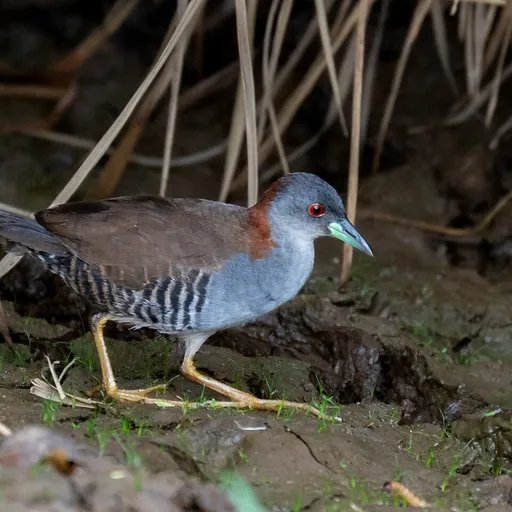
Grey-breasted Crake
Laterallus exilis
Least Concern
Overview
The grey-breasted crake (Laterallus exilis) is a small rail found across Central and South America, classified as Least Concern on the IUCN Red List despite a believed decrease in population. It inhabits diverse environments ranging from wetlands to dry pastures.
Identification
- Adults feature a pale gray head and breast, a white throat, and a chesnut nape, with olive brown upperparts and flanks heavily barred black and white.
- The bird is 14 to 15.5 cm long, with males weighing 26.5 to 39 g and females 29 to 43 g.
- Vocalisations include a series of 2–10 'tink' or 'keek' notes, a descending musical rattle, and a quiet, sharp 'check'.
Habitat
Found in Belize, Central America, Trinidad, and most mainland South American countries except Chile and Uruguay, the species occupies varied landscapes including marshes, river edges, wet meadows, rice fields, pastures, and airfields. It is common in Amazonia but local and uncommon in Central America.
Diet
The diet consists mostly of insects from several orders, as well as spiders, worms, and seeds. The specific foraging technique of the grey-breasted crake has not been described.
Did you know?
The bird constructs a spherical nest made of woven grass and weed stems that features a distinct side entrance.
Sources
- Wikipedia · CC BY-SA 4.0
- Wikidata · CC0 1.0