
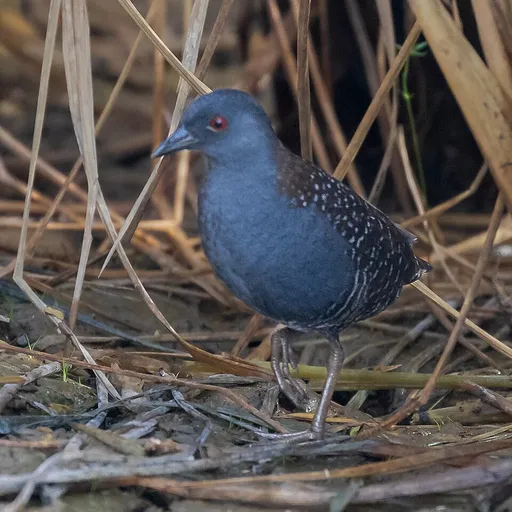
Black Rail
Laterallus jamaicensis
Endangered
Overview
The black rail (Laterallus jamaicensis) is a secretive, mouse-sized member of the rail family and the smallest rail in North America. It is currently classified as Endangered on the IUCN Red List, with an estimated 10,000 to 50,000 mature individuals remaining.
Identification
- A small, dark bird measuring 12–15 cm in length, weighing 29–46 g, and possessing a short bill and dark legs.
- The body is black with white speckles along the back and wings; the eye is brown in juveniles but turns red at around three months old.
- In North America, it produces a distinctive ki-ki-krr call or an aggressive growl, primarily uttered at night.
Habitat
Found in scattered parts of North America, the Caribbean, and South America, usually in coastal salt marshes but also in some freshwater marshes. The species prefers high marsh habitats with large stretches of grasses, such as marsh-hay cordgrass, which provide concealed cover for nesting and foraging. The largest populations in North America are located in Florida and California.
Diet
An opportunistic feeder, the black rail consumes a wide range of food including seeds, insects, crustaceans, and mollusks. It forages along the water lines after high and low tides, often targeting mud-dwelling invertebrates in wetter, inundated marsh areas.
Did you know?
The eastern black rail is nicknamed the 'feathered mouse' and is considered one of the most understudied marsh birds in North America due to its secretive nature. A breeding population in South Carolina was only rediscovered in 2015 using camera traps, and the first breeding population in Louisiana was documented in 2023.
Sources
- Wikipedia · CC BY-SA 4.0
- Wikidata · CC0 1.0