
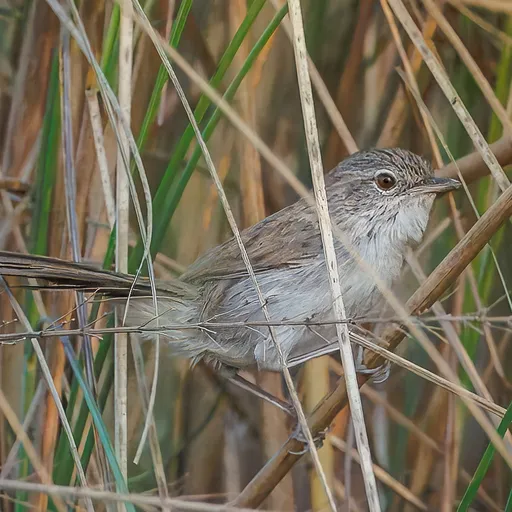
Swamp Grass Babbler
Laticilla cinerascens
Endangered
Overview
The swamp grass babbler, or swamp prinia, is a small bird of the Indian subcontinent classified as Endangered on the IUCN Red List. It is occasionally considered a subspecies of the rufous-vented grass babbler by some authorities, though it is treated as a separate species following the Handbook of the Birds of the World and Clements.
Identification
- Adults are olive-grey above with a slightly warmer tone on the nape and upper back, featuring bold dark streaking from the forehead that fades on the back.
- Underparts are greyish white, greyer on the flanks with faint buff undertail coverts, contrasted by a conspicuous white eye-ring and whitish lores.
- Measures approximately 17 cm in length, with a long, strongly graduated tail where the outermost feathers are only one-third the length of the central ones.
- Song consists of a loud, liquid warble about four seconds long, comparable to that of a dunnock, often accompanied by a wheezy 'feez' and rapid nasal rattle.
Habitat
Found in the plains of the Brahmaputra and Cachar district in Assam, India, and in nearby parts of northern Bangladesh. It inhabits areas with tall grasses or bushes, such as sarkhan, elephant grass, and reedbeds, often near large rivers or swamps, and can even survive in deserts with scattered tall grass.
Diet
This species feeds on insects, foraging by skulking low in grass tussocks where it hops and threads its way through the vegetation, often in small groups.
Did you know?
The bird's song is described as a liquid, loud warble lasting about four seconds that bears a striking resemblance to the song of a dunnock. Its tail is so strongly graduated that the outermost feathers are only one-third the length of the central pair, giving it a distinct appearance in flight.
Sources
- Wikipedia · CC BY-SA 4.0
- Wikidata · CC0 1.0